
Home renovations in Malaysia are regulated under the UBBL 1984 and local council by-laws, with additional strata management rules for high-rise properties. Permit requirements, working hours, and approval processes vary, and non-compliance can result in fines or stop-work orders, making proper planning and written approvals essential in 2026.

Understanding construction working hours in residential areas Malaysia is essential for both homeowners and contractors. Whether you are planning a renovation or dealing with nearby development, knowing the permitted hours helps avoid unnecessary conflict and potential penalties.
Across Malaysia, each local council sets its own rules, but the underlying aim is the same: to balance progress with residents’ right to peace. These regulations dictate when noisy work can begin, when it must stop, and which activities are allowed at different times of day.
For property owners, this knowledge ensures that renovations remain compliant and respectful of neighbours. For tenants and homebuyers, it also helps set expectations, especially if you are moving into an area with ongoing or upcoming development.
With that in mind, here is a clear, updated breakdown of how construction hours in residential areas typically work and what you should be aware of in 2026.
The Legal Framework: UBBL 1984 & Local Authorities
A clear legal framework governs renovation and construction activities in Peninsular Malaysia, but the rules can vary significantly from one area to another.
At the national level, the Uniform Building By-Laws 1984 (UBBL 1984), made under the Street, Drainage and Building Act 1974 (Act 133), set the foundation for what is allowed.
However, how these rules are interpreted and enforced depends mainly on your local authority.
1. How Local Councils Enforce the Rules
City halls and municipal councils apply UBBL through their building-control departments.
Because each council has its own processes, the following may vary from district to district:
- Whether a renovation permit is required
- Approved construction and working hours
- Noise limits or nuisance restrictions
- Inspections and approval timelines
This means that regulations in DBKL may look slightly different from those in MBPJ, MPSJ, MBSA, or other councils.
2. Additional Rules for Strata and Gated Homes
If you live in a condominium, apartment, or gated community, there is another layer of compliance. Renovations must also follow the property’s:
- Deed of Mutual Covenants (DMC)
- House Rules
- JMB/MC renovation guidelines
These often include stricter rules on working hours, types of work allowed, lift usage, deposits, and contractor access.
3. Why You Must Check Both Sets of Rules?
There is no universal renovation rulebook for all of Malaysia. Every homeowner or tenant must confirm:
- Local council by-laws: for permits, noise rules, and allowable working times.
- Building management rules: for property-specific restrictions.
Checking both helps you avoid fines, delays, or renovation disputes before work even begins.
Together, these overlapping rules make it essential for homeowners to verify all requirements upfront to ensure a compliant, hassle-free renovation process.
Do You Need a Home Renovation Permit?

Before you start any form of renovation, it helps to understand when approval is legally required and who has the authority to grant it.
- Under the UBBL 1984 (and the parent Street, Drainage and Building Act), any substantial work, such as erecting partitions, adding walls, or making structural changes, requires prior written approval from the local authority.
- Suppose you proceed without the required permit or approved plan. In that case, you may face fines, orders to stop work, or even demolition of unauthorised works, particularly if there is a neighbour or public complaint.
- For strata/townhouse/apartment properties: Even if local authorities are okay, you still need the consent of your property management (JMB/MC), especially for interior structural changes, hacking, balcony changes, façade works, or external modifications.
Ensuring you have the proper permits and clearances from all relevant parties will save you from costly disputes and keep your renovation fully compliant.
What Are Common Working Hours for Renovation & Construction?
While there’s no universal nationally mandated “working hours” law for all renovations, common practice and many management-body rules reflect these typical windows:
| Typical Permitted Hours | Monday to Friday | Saturday | Sunday & Public Holidays |
| General renovation & light works | 9:00 am – 5:00 pm (or 5 – 6 pm) | 9:00 am – 1:00 pm | Usually, no work is permitted |
| Hacking/drilling/heavy works/noisy works | Often further restricted, sometimes only allowed between 10:00 am and 3:00 pm, or similar narrow windows. | Often not permitted, many management rules prohibit noisy work on Saturdays. | Generally prohibited |
Examples from Real Cases
- A typical condo House Rule sets renovation working hours at Monday-Friday 9 am-5 pm; Saturday 9 am-1 pm; no work on Sundays or public holidays.
- Some groups impose even stricter rules for noisy work (hammering, drilling), allowing it only in limited windows, e.g., 10 am-3 pm on weekdays, none on weekends/holidays.
- For landed houses in Kuala Lumpur, the Dewan Bandaraya Kuala Lumpur (DBKL) now issues renovation permits valid for only one year. If the renovation isn’t completed within that year, homeowners must apply for a renewal (up to three).
What does this mean for you?
- Always check whether your project requires permission, heavy work, or structural changes; external alterations almost always do.
- Expect working hours to be limited to daytime on weekdays and possibly half a day on Saturday. Avoid planning noisy work on Sundays or public holidays.
- If you live in a strata/gated community, check your DMC/house rules; hours may be more restrictive than local-authority norms.
- Plan realistically: don’t assume contractors can work nights or round the clock without a prior clear permit and community consent.
By keeping these time limits in mind and checking both council rules and management guidelines upfront, you can avoid disputes, prevent enforcement issues, and ensure your renovation progresses smoothly.
What Approvals/Documents Are Typically Required

If you’re doing a renovation, you’ll likely need to submit:
- Renovation permit application (with plans/sketches from a qualified architect or registered building draughtsman).
- For structural works (load-bearing walls, beams, external extensions): engineer’s report and structural plan.
- For strata/apartment/condo: a formal renovation request/consent letter from your Management Corporation / JMB / MC; often includes a deposit or compliance guarantee.
- A work schedule (when works start/ends each day), especially if heavy works are involved (to address noise/disturbance concerns). Many management bodies require this.
Failing to obtain proper approvals can result in fines, stop-work orders, or even demolition of unauthorised works.
What Happens if You Renovate Without a Permit or After Hours?

Before you begin any work, it’s essential to understand the real implications of carrying out renovations without proper approval or outside the permitted hours:
- Under UBBL 1984/Street, Drainage and Building Act, unapproved structural modifications or additions are unlawful.
- Local councils may issue fines, orders for demolition, or compulsorily require you to revert work.
- Suppose you live in gated or strata communities. In that case, management bodies can impose additional sanctions: fines, refusal to cooperate with the handover of keys, or denial of occupancy or access to shared facilities.
- Prolonged renovations without completion may trigger permit expiration. In major cities (e.g., KL), permit validity is limited to 1 year, after which you’d need to renew.
By keeping within legal requirements and approved time windows, you protect yourself from penalties, avoid neighbour disputes, and ensure your renovation progresses smoothly.
Review instalment estimates early with the calculator.Why Renovation Compliance Matters More Than Ever?
As renovation timelines and enforcement trends continue to evolve, it helps to stay aware of the latest shifts shaping how councils regulate household construction.
- In 2022-2024, messages from authorities and the media show an increase in public complaints about “never-ending renovations.” As a result, some local councils, such as DBKL, have started capping permit durations at 1 year. Homeowners must renew if they don’t finish.
- There is growing emphasis on public interest, environmental impact, noise control, and community disturbance. Local authorities seem more willing to enforce working-hour rules and stop work if disturbances are reported (nuisance, dust, noise). This means that renovation or construction of any scale must be carefully planned and approved.
Taken together, these developments signal a firmer, more structured approach to renovation oversight, one that requires homeowners to plan, stay compliant, and remain mindful of their surrounding community.
What Homeowners Should Do (Before Starting Work)
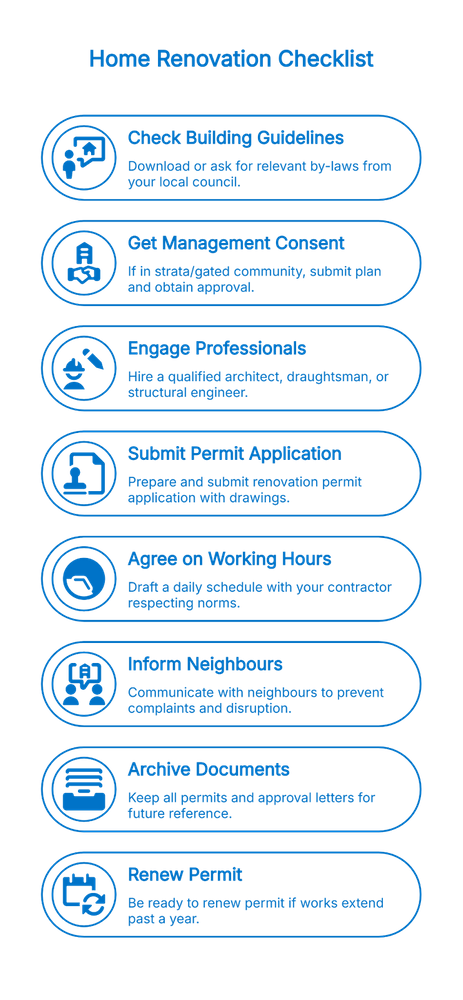
If you plan to renovate or modify your house, here’s a checklist:
- Check your local council’s building guidelines, and download or request the relevant by-laws (many councils have “Renovation Guidelines” documents). For example, DBKL has a “Guidelines for Working Hours at Construction Sites in the Federal Territory of Kuala Lumpur” (2025 version).
- If living in a strata/gated community, obtain MC/JMB/Management consent first, submit the plan, obtain the approval letter, and make any required security deposit.
- Engage a qualified architect, draughtsman, or structural engineer if structural, external,l or significant renovation, not just a contractor.
- Prepare and submit a renovation permit application (with drawings/plans), and wait for formal approval before starting.
- Agree on working hours with your contractor, draft a daily schedule that respects community norms and local by-laws.
- Inform neighbours, especially in high-density or strata settings, being communicative can prevent complaints and disruption.
- Archive all permits and approval letters, suitable for future sale, property records, and compliance.
- If works drag past a year (in KL or similar councils), be ready to renew the permit; don’t assume open-ended renovation is permitted anymore.
By completing these steps upfront, homeowners can avoid costly setbacks, maintain good neighbourly relations, and ensure their renovation proceeds smoothly and in full compliance with the law.
Common Myths & Misconceptions (And Realities)
Before starting any renovation, it helps to clear up a few common misunderstandings that often lead to disputes, delays, or non-compliance, especially in urban councils and strata developments.
| Myth | Reality |
| “Minor renovation = no permit needed.” | Even “minor” changes (such as partitions, built-in wardrobes, or wall removal) may legally require a permit under UBBL. |
| “I can renovate any time; the contractor will be quiet.” | Noise work (hacking, drilling) is often restricted to certain hours; many rules forbid noisy work on weekends and holidays. |
| “As long as it’s inside my unit, I don’t need MC consent.” | For strata/apartment units, internal works often still require MC approval under the Deed of Mutual Covenants/House Rules. |
| “I can take months to finish the renovation; the permit doesn’t expire.” | In many councils (e.g., Kuala Lumpur), renovation permits now expire after 1 year; extensions require a new application. |
Understanding these realities early on will save you time, prevent unnecessary conflict, and ensure your renovation progresses smoothly within the rules.
What This Means If You’re Renovating?
Before you start any work, it’s essential to understand how these new rules shape your planning, scheduling, and execution of your renovation.
- Plan renovation as a single project: don’t treat it as episodic or “whenever I have time.”
- Choose experienced, licensed contractors who know local laws; avoid fly-by-night operators promising 24/7 work.
- Schedule noisy works early in the day: drilling, demolition, or heavy construction are best done between 9 am-3 pm on weekdays (if allowed), to minimise resident complaints.
- Communicate with neighbours early: provide notice, apologise for noise, and manage expectations.
- Keep paperwork: permits, MC consent letters, work schedule, contract, and receipts, for compliance, future sale, or if there’s a dispute.
By aligning your renovation plans with these guidelines, you’ll avoid unnecessary delays, maintain good neighbour relations, and ensure your project progresses smoothly from start to finish.
Renovate Smart, Renovate Compliantly
Renovation can transform a house into your dream home, but in Malaysia, it comes with legal, social, and community responsibilities.
The combined regulatory framework of the UBBL 1984, local authority by-laws, and strata/gated-community rules means you must do your homework before you start. Simple steps, like obtaining a permit, agreeing on working hours, managing garbage, and making safety deposits, go a long way toward avoiding fines, neighbour disputes, or even demolition orders.
With precise planning, proper approvals, and respectful execution, you can enjoy a smooth renovation process and a comfortable home at the end.Ready to take the next step? Start exploring the latest property listings on iProperty Malaysia and find a home that truly matches your goals.