

You may have bought your home and collected the keys years before receiving a notice to complete the Perfection of Transfer (POT). This usually happens when the property was purchased before its individual or strata title was available.
Once the separate title is issued, POT allows the property to be formally transferred and registered in your name as the registered proprietor. The process can involve legal fees, stamp duty, registration fees, and other related expenses that buyers should prepare for.
This guide explains when POT is required, how the transfer process works, the costs you may need to budget for, and how a POT legal fees calculator can help you understand how the legal fees are calculated.
<a href=”https://www.iproperty.com.my/property-for-sale”><strong>Search properties for sale in Malaysia and compare available homes.</strong></a>What Is Perfection Of Transfer In Malaysia?
Perfection of Transfer is the process of registering the purchaser as the registered proprietor after an individual or strata title has been issued.
This commonly arises when a property was initially purchased while the development was still held under a master title. At that stage, there was no separate title available for the purchaser’s property to be registered directly in their name.
Once the individual or strata title is issued, the transfer can be perfected through the relevant instrument of transfer, generally Form 14A under the National Land Code.
In simple terms, POT completes the registration of ownership that could not be completed when the property was originally purchased.
When Do You Need To Complete Perfection Of Transfer?
POT becomes relevant once the individual or strata title is issued for a property that was originally purchased under a master title. You may need to proceed with POT when:
- The individual or strata title has been issued: The property can now be transferred from the developer or landowner to you as the registered proprietor.
- You receive a notice to complete the transfer: The developer or solicitor may contact you after the separate title becomes available and request that you proceed with POT.
- You bought the property before the separate title was available: This commonly applies where the original purchase could not be registered directly against an individual or strata title.
- Your housing loan is still outstanding: In this case, POC may also need to be completed so the financier’s charge can be registered against the newly issued title.
Receiving vacant possession or living in the property does not by itself mean that POT has already been completed.
What Is Perfection Of Charge?
POC applies when a property is subject to financing, and the individual or strata title was not available when the financing transaction was originally completed.
Once the separate title is issued and ownership is registered, the financier’s security can be registered against the title.
Under the National Land Code, Form 16A is the prescribed charge form used to secure payment of a principal sum. The registered proprietor charges the property in favour of the financier, making the financier the registered chargee.
POC does not transfer ownership of the property to the bank. Rather, it registers the bank’s security interest over the title.
Perfection Of Transfer Vs Perfection Of Charge: What Is The Difference?
Although POT and POC can take place around the same time, they serve different purposes. Understanding the distinction can help property owners know which registration applies to their ownership and financing arrangements.
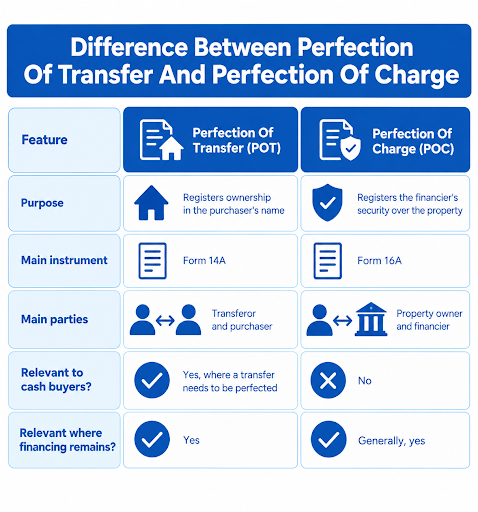
Together, POT and POC ensure that the property’s ownership and financing arrangements are properly reflected on the title once it becomes available. For financed properties, this means the purchaser is registered as proprietor while the financier’s interest is recorded separately against the title.
How Does The Perfection Of Transfer Process Work?
The exact procedure can vary depending on the property, state requirements, and circumstances of the transaction. Generally, the process may involve:
- Issuance of the title: The individual or strata title for the property is issued.
- Notification: The purchaser is informed that the title is available for transfer.
- Appointment of a solicitor: The purchaser instructs a solicitor to handle the POT.
- Preparation of documents: The relevant transfer documents, including Form 14A where applicable, are prepared.
- Execution: The relevant parties sign the required documents.
- Stamping and other requirements: Applicable stamp duty, consent requirements, and supporting documents are dealt with.
- Registration: The transfer is presented to the relevant Land Office or Registry for registration.
Once registered, the purchaser becomes the registered proprietor on the individual or strata title.
Perfection Of Transfer Legal Fees Calculator: How Are Fees Calculated?
A POT legal fees calculator should take into account the current Solicitors’ Remuneration Order 2023 (SRO 2023), which came into effect on 15th July, 2023.
For sale and transfer transactions under Table A of the First Schedule, the current scale is:
| Consideration Or Adjudicated Value | Scale Fee |
| First RM500,000 | 1.25%, subject to a minimum fee of RM500 |
| Next RM7,000,000 | 1% |
| Above RM7,500,000 | Negotiable on the excess, but not exceeding 1% of the excess |
However, this does not mean a purchaser necessarily pays the full scale fee again for POT.
Under the Sixth Schedule of SRO 2023, where the solicitor handled the original transaction before the individual or strata title was issued, the fair and reasonable remuneration for completing the subsequent transfer must not exceed 25% of the applicable scale fee, subject to the specified minimum fee.
Where a solicitor handles the transaction after title issuance but did not handle the earlier transaction, the fee must not exceed 50% of the applicable scale fee, subject to the specified minimum fee.
Example: POT Legal Fee For A RM500,000 Property
Using the Table A scale:
RM500,000 × 1.25% = RM6,250
The potential maximum POT professional fee would therefore be:
| Situation | Illustrative Maximum Fee |
| Solicitor handled the original transaction | RM6,250 × 25% = RM1,562.50 |
| Solicitor did not handle the original transaction | RM6,250 × 50% = RM3,125 |
These calculations illustrate the professional fee framework only. The actual amount payable may depend on the circumstances of the transaction and applicable minimum fee.
<a href=”https://www.iproperty.com.my/financing/mortgage-calculator/”><strong>Calculate your estimated monthly repayments with the Mortgage Calculator. </strong></a>What Other Perfection Of Transfer Costs Should You Budget For?
A POT legal fees calculator does not necessarily show the total amount a property owner will need to pay.
Apart from the solicitor’s professional fee, other expenses may include:
- stamp duty, where applicable
- Land Office or Registry registration fees
- title and land searches
- consent-related fees or expenses, where required
- certified copies or extracts
- other properly incurred disbursements
SRO 2023 distinguishes professional remuneration from expenses such as stamp duty, registration fees, search fees, and other disbursements. Property owners should therefore ask for an itemised quotation rather than assuming the legal fee represents the complete POT cost.
Do You Have To Pay MOT Stamp Duty Again During Perfection Of Transfer?
Whether additional Memorandum of Transfer (MOT) stamp duty is payable during POT depends on the documents executed and how stamp duty was dealt with during the original property transaction.
Where a separate title was not yet available, the Malaysian Bar states that solicitors should not collect stamp duty and other disbursements for the transfer or charge until the separate title has been issued. As stamp duty is imposed on instruments, buyers should check their original stamped documents and the applicable duty before calculating the total POT cost.
From 1st January, 2026, stamp duty processes are handled through the e-Stamp Duty system via MyTax. The Stamp Duty Self-Assessment System (STSDS) is also being introduced in phases, with the first phase covering leases or tenancies, securities, and general instruments.
<a href=”https://www.iproperty.com.my/guides”><strong>Read Property Guides for useful insights on Malaysia’s property market.</strong></a>What Documents May Be Required For Perfection Of Transfer?
The exact requirements can vary depending on the property and transaction, but purchasers may be asked to provide documents such as:
- National Registration Identity Card (NRIC) or passport
- Sale and Purchase Agreement (SPA)
- Individual or strata title details
- Latest assessment receipt
- Latest quit rent or parcel rent receipt
- Developer-related documents
- State Authority consent documents, where applicable
- Other supporting documents requested by the solicitor or relevant authority
Check the exact document requirements with the solicitor handling your POT, as additional documents may be required depending on the property and title.
Who Is Involved In Perfection Of Transfer?
Completing POT involves several parties responsible for preparing, executing, stamping, and registering the transfer. Understanding who handles each stage can help you know what to expect during the process.
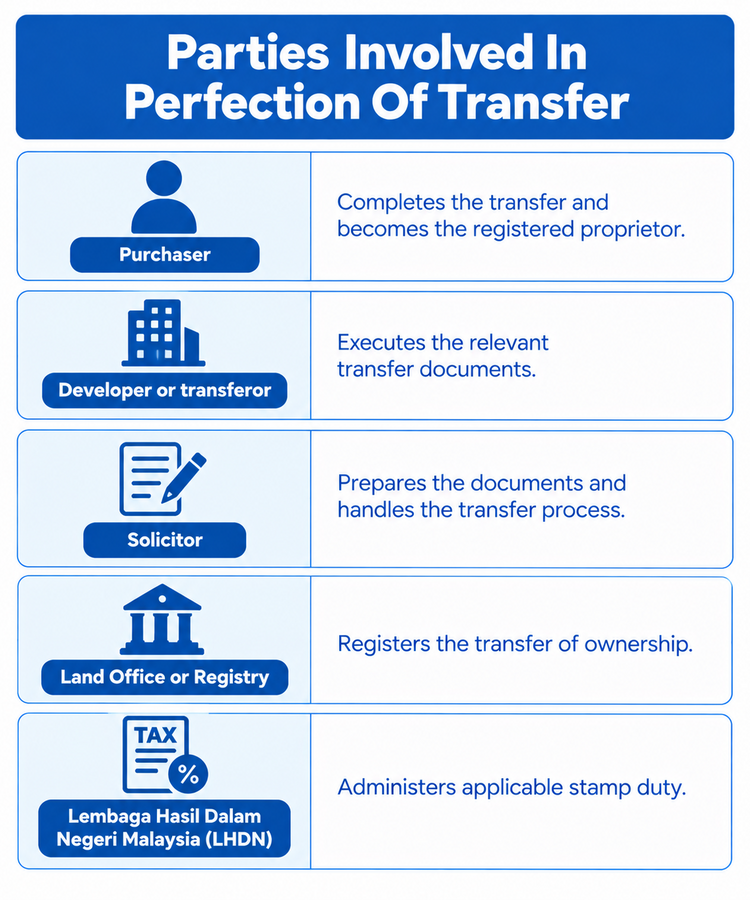
Each party has a specific role in completing POT. Your solicitor generally coordinates the required documents, execution, stamping, and registration with the relevant parties and authorities.
Can You Use A Different Lawyer For Perfection Of Transfer?
Property owners can generally appoint a different solicitor to handle POT, but this may affect the professional fees. Under the Solicitors’ Remuneration Order 2023 (SRO 2023), the solicitor who handled the original transaction may charge up to 25% of the applicable scale fee for the subsequent transfer.
If a different solicitor is appointed after the individual or strata title is issued, the fee may be up to 50% of the applicable scale fee, subject to the specified minimum. Consider this difference when using a POT legal fees calculator to estimate costs.
What Happens If You Delay Perfection Of Transfer?
Delaying POT means the purchaser remains unregistered as the proprietor of the individual or strata title. This can create complications later, particularly when another property transaction is required.
Potential issues include:
- Selling the property may become more complicated: The outstanding transfer may need to be resolved as part of the subsequent sale.
- Refinancing may face additional steps: A new financier may require the title and ownership position to be regularised before completing the financing.
- Future dealings with the title can be affected: Transactions that require the registered proprietor’s involvement may be more difficult while POT remains outstanding.
- Documents may become harder to obtain: Long delays can make retrieving old SPA, financing, developer, or transfer documents more difficult.
- Coordination may become more complex: Changes involving the developer, original solicitor, financier, or other parties over time can add steps to the process.
Once notified that the individual or strata title has been issued, purchasers should check the POT requirements and costs rather than leaving the transfer unresolved.
Completing Perfection Of Transfer With The Right Preparation
POT completes the registration of ownership once an individual or strata title is issued. Completing POT promptly can help avoid complications when selling, refinancing, or dealing with the property later.
A POT legal fees calculator can provide an initial cost estimate, but stamp duty, registration fees, searches, and other disbursements may also apply. Request an itemised quotation from your solicitor before proceeding.
Looking for a newly launched home? Explore new property developments in Malaysia and find your next home on iProperty Malaysia.