
Not sure whether freehold or leasehold is the smarter choice in 2026? This guide breaks down the real difference between leasehold and freehold in Malaysia, including ownership rights, financing rules, renewal costs, resale impact, and investment potential. Learn how tenure affects value, loans, and long-term plans so you can choose a property that truly fits your goals.

✉️Subscribe to us on Telegram for the latest property insights and updates.
Buying your first home or next investment property in Malaysia comes with many decisions, but one of the most important is choosing between freehold vs leasehold land title. While many homebuyers assume that freehold automatically means better, the real answer depends on your goals, long-term plans, and budget.
Understanding the difference between leasehold and freehold now is more important than ever.
With rising land costs in Kuala Lumpur, Selangor, Penang and Johor, as well as ongoing urban redevelopment, both types of land title come with advantages, trade-offs, and financial implications worth knowing before you sign your Sales and Purchase Agreement (SPA).
This guide updates the existing information with 2026 relevant insights, including the latest market trends, financing considerations, strata rules, resale challenges, as well as the pros and cons buyers need to evaluate clearly.
What Are Freehold and Leasehold Titles in Malaysia?
In Malaysia, all land belongs to the State Government under the National Land Code, 1965. Ownership transferred from the State to individuals or entities falls under one of two main categories:
- Freehold
- Leasehold
Understanding the difference between leasehold and freehold helps buyers assess:
- Long-term ownership
- Disposal rights
- Capital appreciation
- Bank financing strength
- Renewal obligations
- Resale value
Both titles are legal, widely sold, and available in both landed and high-rise (strata) developments.
Why Land Titles Matter in 2026?

Between 2023 and 2025, Malaysia’s urban growth has intensified in Greater Kuala Lumpur, Selangor, Johor Bahru and Penang. This has resulted in:
- Limited availability of freehold land in central urban areas
- More new developments are being launched under a leasehold
- Higher strata living demand due to urban density
- Greater emphasis on long-term financing risk
Therefore, the debate around freehold vs leasehold is no longer just academic; it directly affects affordability, liquidity, loan eligibility and wealth planning.
Freehold Title: Meaning and Characteristics
A freehold property gives the buyer perpetual ownership, subject only to the National Land Code and any planning limitations. It gives the homeowner more autonomy over the land and, in most cases, a stronger long-term resale value.
If a developer acquires freehold land, the initial document is typically the Master Title. Upon completion, owners may receive:
- Individual Title (landed homes), or
- Strata Title (high-rise units)
Even under freehold strata, the owner technically shares ownership of the land beneath the condominium with all other parcel owners.
Pros and Cons of Freehold Property
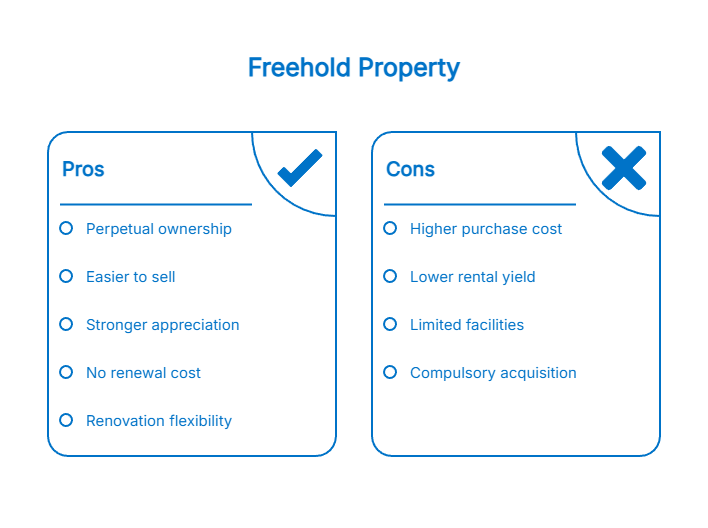
Freehold properties offer long-term security and ownership advantages, making them appealing for buyers seeking stability and potential capital growth. Understanding the pros and cons ensures informed decision-making before purchase.
1. Advantages of Freehold
- Perpetual ownership with no expiry
- Generally easier to sell due to stronger buyer confidence
- Typically, stronger long-term capital appreciation
- No lease renewal cost
- More flexibility for renovation and rebuilding, subject to local council approval
2. Disadvantages of Freehold
- Usually more expensive to purchase
- Lower rental yield due to higher entry cost
- Facilities may be limited, especially in older landed neighbourhoods
- If the State Government requires the land for public infrastructure, compulsory acquisition may still occur under the Land Acquisition Act 1960
While freehold properties provide perpetual ownership and flexibility, they often come with higher costs and limited facilities. Evaluating these factors helps buyers align their investment with budget, lifestyle, and long-term goals.
Leasehold Title: Meaning and Characteristics
A leasehold property does not grant perpetual ownership. Instead, the land is leased from the State for a fixed period, usually:
- 30 years
- 60 years
- 99 years
- Up to 999 years (rare today)
Once expired, the owner must apply for an extension, subject to a premium payment calculated based on:
- Remaining years
- Market land value
- State assessment formulas
Leasehold developments tend to dominate established urban centres where freehold land is no longer available.
Pros and Cons of Leasehold Property
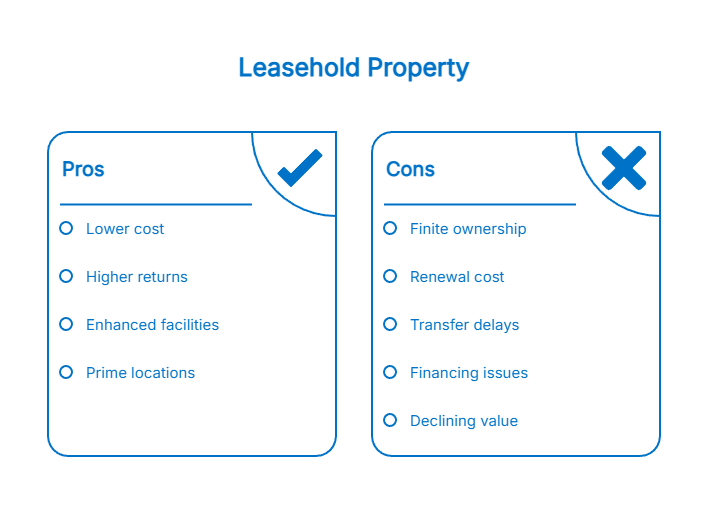
When considering leasehold properties, it is important to weigh both the advantages and limitations. Understanding these factors can help buyers make informed decisions based on budget, location, and investment goals.
1. Advantages of Leasehold
- Lower entry cost, often 15% to 25% cheaper than freehold equivalents
- Higher rental returns due to lower purchase price
- Developers tend to enhance appeal with better facilities such as gyms, parks, sports courts or community spaces
- Leasehold may allow buyers access to high-demand locations (e.g., Shah Alam, Petaling Jaya, Subang Jaya, Cyberjaya)
2. Disadvantages of Leasehold
- Ownership is finite and ends when the lease expires
- Renewal involves a premium payment
- State consent is required before transfer, slowing down transactions
- Banks may be reluctant to finance units with remaining tenure below 50 years
- Older units may experience declining market value
While leasehold properties offer affordability and attractive amenities, buyers must account for finite ownership, renewal costs, and potential financing challenges. Careful evaluation ensures the property aligns with both lifestyle and long-term plans.
Loan and Financing Considerations in 2026
Banks in Malaysia evaluate leasehold properties more conservatively. This means lenders may apply stricter criteria or adjust financing terms compared to freehold properties. Key considerations include:
- Financing is usually easiest when the remaining tenure is 75 years or more
- Between 50 to 74 years, the loan margin may be reduced
- Below 50 years, financing becomes difficult, and the buyer pool shrinks significantly
- Refinancing is also affected by tenure
For freehold units, banks typically offer financing up to 90%, subject to LTV (Loan-to-Value) rules and buyer profiles.
This financing reality is one of the clearest differences between leasehold and freehold properties in Malaysia today.
Lease Renewal Costs and How They Are Calculated
For leasehold properties, understanding lease renewal costs is essential before making a purchase, especially if you plan to hold the property long-term. Each State Government in Malaysia applies its own calculation formula, but the key factors generally include:
- Current Land Market Value: The prevailing market price of the land as assessed by the State or appointed valuers.
- Size of the Land: Larger plots or units may incur higher premiums.
- Remaining Lease Tenure: The shorter the remaining lease, the higher the cost of extension per year.
- State Premium Rate: Each State sets its own rate, which may vary depending on location, demand, and land type.
Some States offer early renewal incentives. For example, if you apply for an extension before the lease drops below a certain threshold (commonly 60 years), the premium payable may be discounted.
Step-by-Step Renewal Process:
- Submit an application to the State Land Office before the lease expires.
- The State calculates the premium based on the above factors.
- Pay the premium, after which a new lease document is issued, typically extending the tenure by 30, 60, or 99 years.
Start the renewal process early to avoid complications. Some banks also consider the remaining tenure when approving financing, so ensuring timely renewal can protect both your investment value and loan eligibility.
Renovation and Redevelopment Opportunities
When comparing freehold vs leasehold, renovation and redevelopment potential is a critical factor. Properties with longer tenures or fewer restrictions often offer greater flexibility for upgrades, extensions, or future redevelopment plans.
Freehold Properties:
- Offer greater autonomy over land and structures.
- Owners can upgrade interiors, extend living spaces, or subdivide land, subject to local council approval.
- Ideal for long-term homeowners or investors who want to increase property value over time.
- Particularly advantageous in prime areas where redevelopment can yield higher resale gains.
Leasehold Properties:
- Renovations may require State or management approval, especially for high-rise units.
- Shorter leases may limit extensive upgrades or expansions.
- Many leasehold developments already include modern facilities, reducing the need for personal redevelopment.
Freehold properties appeal to those prioritising flexibility and long-term value, while leasehold units require strategic planning to maximise living comfort within tenure restrictions. Understanding these differences ensures renovation and future improvements align with your lifestyle and investment goals.
Amenities and Lifestyle Considerations
Amenities often influence property choices beyond tenure. Access to nearby schools, shopping, dining, and recreational facilities can significantly impact convenience, daily living, and long-term property value.
Leasehold Units:
- Developers usually provide gyms, pools, parks, and community spaces.
- Attractive for urban professionals, families, and first-time buyers.
- Professional management ensures facilities are maintained.
Freehold Units:
- Landed freehold offers private gardens and outdoor space.
- Strata freehold relies on shared facilities managed collectively.
- Provides flexibility to personalise spaces but may require additional effort and investment.
In 2026, a well-located leasehold property with modern amenities may offer a better daily living experience than a freehold property in a less connected area. Location, accessibility, and lifestyle benefits should be weighed alongside tenure before making a decision.
Investment Scope and Exit Strategy
Your investment horizon matters when deciding between freehold vs leasehold. Considering potential resale value, market demand, and the duration you plan to hold the property can help shape a clear exit strategy.
Freehold Properties:
- Perfect for long-term holding with predictable appreciation.
- Easier to sell in the secondary market due to perpetual ownership.
- Suited for investors focusing on capital growth or legacy planning.
- Stronger bank financing options enhance resale and refinancing prospects.
Leasehold Properties:
- More suitable for short- to medium-term investment.
- Lower entry prices can deliver higher rental yields initially.
- Value may decline as lease tenure shortens; renewal costs may affect profitability.
- Banks may limit financing for properties with less than 50 years remaining.
Plan your exit strategy early. Freehold suits long-term wealth accumulation, while strategically located leasehold units can deliver short-term gains and rental income in high-demand areas.
Market Trends and Value Growth in 2026

Learning the market trends is essential when comparing freehold and leasehold properties. Awareness of value growth patterns can help buyers make informed investment decisions.
1. Freehold market patterns
Freehold units historically show:
- Stable price appreciation
- Better resistance against inflation
- Higher buyer confidence in the secondary market
In high-demand areas such as Petaling Jaya, Cheras or Bangsar, freehold landed properties remain extremely limited, further reinforcing demand.
2. Leasehold market patterns
Leasehold values tend to follow this cycle:
- Significant growth in the first 20 to 30 years
- Then flattening
- Gradual decline if tenure becomes short without renewal
However, well-located leasehold units close to MRT stations, highways or job clusters remain highly competitive despite tenure limitation.
While freehold properties generally offer long-term stability, well-located leasehold units can still deliver strong returns. Ultimately, location, demand, and remaining tenure play key roles in property value growth.
Explore new residential launches in Malaysia.Common Misconceptions About Land Titles
Many property buyers in Malaysia have persistent doubts about freehold vs leasehold. Understanding the realities can help avoid costly assumptions and make informed decisions.
1. Freehold land can never be taken back
Not true. Under the Land Acquisition Act 1960, the State has the right of compulsory acquisition for public projects such as highways or train lines, subject to compensation.
2. Leasehold properties always lose value
Value increases in early years and can be maintained if:
- The lease is extended
- Location is strong
- Facilities and management are competitive
- Buyer pool is healthy
3. Leasehold transfer always takes one year
Primary market transfers are faster. Secondary market transfers vary depending on State approval volumes, often four to twelve months.
Clearing up these misconceptions helps buyers set realistic expectations and confidently assess which property tenure aligns with their investment and lifestyle goals.
Freehold vs Leasehold: Comparison Table
Before making a decision, it helps to see the main differences between freehold vs leasehold side by side. This comparison highlights ownership, financing, value, and other key factors for Malaysian homebuyers.
Here is the full comparison table:
| Criteria | Freehold | Leasehold |
| Ownership | Perpetual, unless a restricted title or compulsory acquisition | Expires after 30, 60, 99 or 999 years unless renewed |
| Land Ownership | The owner owns the land | Land remains State-owned |
| Capital Growth | Generally strong long-term appreciation | Strong first 20–30 years, then dependent on remaining tenure |
| Renewal Cost | None | Premium payable for extension |
| Transfer Speed | Faster; no State consent required (unless restricted) | Slower; State approval required |
| Loan Financing | Up to 90% financing | Reduced financing once tenure < 75 years; difficult below 50 |
| Property Price | More expensive | Typically 15% to 25% cheaper than freehold property |
| Rental Yield | Lower due to higher price | Higher due to lower entry price |
| Flexibility | More freedom for redevelopment | Lease conditions may restrict development |
| Risk of Reversion | None (except compulsory acquisition) | High if lease is not renewed |
This comparison highlights the practical difference between leasehold and freehold for modern Malaysian buyers. Carefully weighing tenure, location, and amenities ensures your property purchase in Malaysia delivers both comfort and value over time.
Make better property decisions with property guides.Which Is Better for You: Freehold or Leasehold Property
There is no universal winner in the debate of freehold vs leasehold, only what suits your objectives:
Freehold may suit:
- Buyers seeking legacy property for the next generation
- Buyers prioritising ease of resale
- Investors focused on capital growth over long-term yield
- Buyers who prefer fewer restrictions
Leasehold may suit:
- First-time buyers seeking affordability
- Investors looking for stronger rental returns
- Buyers wanting modern facilities at a lower cost
- Buyers wanting strategic locations with a lower entry price
Ultimately, the difference between leasehold and freehold becomes secondary if:
- Location is excellent
- Amenities are competitive
- Demand is strong
- The development is well-maintained
A well-located leasehold property can outperform a poorly positioned freehold one.
How to Check the Title of a Property?

Before deciding between freehold vs leasehold, it’s important to verify the property’s actual tenure. Here are the quickest ways Malaysian buyers can check a property’s title with confidence.
1. Check the Geran / Strata Title
Look at the “Tenure” section on the title document to see if it’s freehold or leasehold.
2. Do a Land Office or Online Title Search
Request a title search report using the property’s lot number to confirm tenure and restrictions.
3. Ask Your Conveyancing Lawyer
Your lawyer can verify the title, remaining lease years and highlight any restrictions.
4. Confirm with the Developer (For New Launches)
Developers disclose the land tenure in brochures, the Sales & Purchase Agreement (SPA) and project documents.
5. Review Bank Valuation Reports
Bank valuations normally state the tenure and remaining lease years, especially for leasehold units.
6. For Strata Units: Check the Master Title
If the strata title hasn’t been issued yet, the Master Title determines the tenure for all units.
These quick checks ensure you know exactly what you’re buying before signing anything. Clear title verification helps you avoid surprises and choose the property that aligns best with your long-term goals.
Wrapping it Up For You
The question of freehold vs leasehold remains one of the most common among Malaysian homebuyers, and for good reason. The difference between leasehold and freehold affects:
- Loan approval
- Resale liquidity
- Investment horizon
- Monthly yield
- Renovation flexibility
- Long-term planning
However, rather than simply assuming freehold is always better, buyers in 2026 should evaluate:
- How long you plan to hold the property
- Your financial priorities (yield vs capital growth)
- Remaining tenure of leasehold units
- Likelihood of loan approval
- Location and demand
Look beyond the title and consider:
- Connectivity
- Job accessibility
- Price growth history
- Building condition
- Amenities
- Market demand
A well-located leasehold development with strong facilities, good management and over 80 years of tenure can be a stronger choice than an ageing freehold property in a disconnected or low-demand area.
Find your ideal rental home in Malaysia. Compare listings, locations, and prices to secure a rental that fits your needs.