
Trying to decide between a service apartment vs condominium in Malaysia? This 2026 guide explains the real differences in land title, utility tariffs, maintenance costs, legal protection, and lifestyle fit. Learn which option works better for long term living, rental yield, and monthly affordability before you commit.
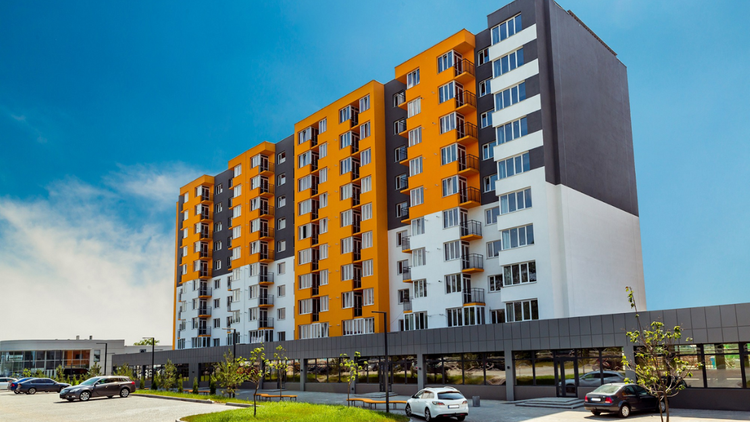
Service apartment vs condominium in Malaysia are not simply a matter of taste. It can change how much you pay each month, the rules you must follow, and even the lifestyle you enjoy day to day.
Both may look similar on the surface, high-rise homes with pools, gyms, and security, yet the differences beneath are what really count: land status, utility charges, zoning rules, and how the property is managed.
As urban living continues to evolve in 2026, buyers and investors are becoming more selective. Should you prioritise convenience and vibrant commercial surroundings, or a quieter residential environment with potentially lower ongoing costs?
This guide breaks down everything clearly:
• What service apartments and condominiums truly are
• How each affects your bills, rights, and long-term value
• Pros and cons for different lifestyles
• Popular projects and investment considerations for 2026
By the end, you will be well equipped to decide which one is the more brilliant move, for your life today and your plans tomorrow.
What Is a Condominium?
A condominium, or “condo” as it is commonly known, is a purpose-built residential property located on residential-titled land. When you purchase a condominium, you own your individual unit outright while also sharing legal ownership of the building’s communal areas, including the lobby, landscaped gardens, swimming pools, gyms, and security facilities.
These shared spaces are jointly managed and funded by residents through a Management Corporation (MC) or Joint Management Body (JMB), ensuring the development stays well-maintained over the long term.
Condominiums are designed with a home-first philosophy, prioritising privacy, comfort, and everyday liveability. They often appeal to residents seeking a well-structured community environment with strong security and a high level of lifestyle value.
Key characteristics of condominiums:
• Residential-titled property: aligns with regulations meant for homes and owner-occupiers.
• Strong buyer protections: usually covered under the Housing Development Act (HDA).
• Amenities built for day-to-day life, such as pools, gyms, meeting rooms, playgrounds, and landscaped parks.
• Shared responsibility: maintenance fees support the upkeep of facilities and common areas.
• Designed for long-term living: ideal for families, professionals, and lifestyle-driven buyers.
Today, condominiums remain one of the most popular urban housing choices in Malaysia, offering residents a lifestyle that balances convenience, community, and comfort, all within a secure, well-managed environment.
What Is a Service Apartment?
A service apartment (often called a serviced residence) blends the comfort of a residential home with the convenience of hotel-style services. These properties are designed for people who want flexibility, a space that functions like a home, but with lifestyle perks you would usually only find in a hotel.
Unlike traditional condominiums, service apartments are typically built on commercial-titled land. This has a direct impact on utility rates, assessments, and overall cost of living, an essential factor for buyers and investors to understand from the beginning.
They are commonly found within integrated developments, connected to retail malls, offices, or transit hubs. This allows residents to live, shop, dine, and commute, all within a single destination.
Here’s what usually defines a service apartment:
• Furnished for immediate move-in
Most are entirely or semi-furnished, including essential furniture, kitchen appliances, and built-in fittings, making them convenient for buyers who want a hassle-free start.
• Hotel-style services and concierge facilities
Depending on the project, residents may enjoy housekeeping, reception counters, valet services, and enhanced hospitality standards.
• Flexible usage for living or rental
The commercial zoning often makes short-term leasing more viable (subject to local council rules), appealing to investors tapping into corporate and expat demand.
• Part of vibrant, connected developments
These homes are usually situated in areas with strong access to public transport, retail options, and business activity, ensuring lifestyle convenience is built in.
Because of this blend of convenience and flexibility, service apartments are especially popular among:
• Busy urban professionals
• Expats and business travellers
• Investors seeking rental-driven income opportunities
• Individuals who prefer low-maintenance city living
Overall, service apartments are ideal for those who want an active, connected lifestyle with minimal upkeep and appreciate the added comfort and prestige of hotel-style amenities.
Service Apartment vs Condominium: Key Legal & Financial Differences

Here’s a detailed comparison of the main differentiators between service apartments and condominiums:
| Aspect | Condominium | Service Apartment |
| Land Title/Zoning | Usually residential-titled land. Buyer owns the residential parcel. | Often commercial-titled; in mixed developments, may be reclassified if approved. |
| Legal Protection | Usually covered by Housing Development Act (HDA) → more buyer protection. | Sometimes not under full HDA coverage, depending on title classification. |
| Utility Tariff | Residential electricity tariff (previously TNB Tariff A). | Commercial electricity tariff (Tariff B or non-domestic). |
| Parcel Rent/Assessment | Parcel rent and assessment taxes are usually lower (residential rate). | Higher parcel rent/assessment for commercial parcels. |
| Maintenance Fees | Residential maintenance rate, depending on MC. | Higher due to operational costs and possible hospitality-style services. |
| Density & Plot Ratio | Often lower-density, residential zoning. | Higher density is possible via commercial zoning and plot ratio. |
| Resident Turnover | More stable, long-term residents. | More transient, mix of travellers, business tenants, investors. |
| Lifestyle/Use | Residential living: family, long-term stay. | Flexible stay: short-term, corporate, or long-term, depending on the model. |
Whether you prioritise stability, lower running costs, and a homely neighbourhood feel, or you value hotel-style convenience and prime connectivity, the decision should reflect how you truly want to live every day.
Which Property Type Fits Your Lifestyle?
Here’s a balanced comparison of the advantages and potential drawbacks of each:
| Property Type | Pros | Cons |
| Condominium | • Sustainable monthly costs (utilities, maintenance)• Legal protection under HDA• Good for long-term investment• Community environment | • Less flexible for short-term stay• Fewer “hotel-like” services• May require furnishing if not fully fitted |
| Service Apartment | • Fully furnished; ready to live in• High convenience with services• Prime locations, often in the city centre• Good rental yield potential | • Higher utility and parcel rent costs• Possibly no HDA protection• Higher maintenance• Less sense of a settled community |
Ultimately, the right choice comes down to how you want to live and what you expect from your investment, whether that is the stability and long-term comfort of a condominium or the flexibility and convenience of a serviced apartment.
Electricity, Parcel Rent & Assessment Tax: A Closer Look in 2025
Before deciding between a condominium and a serviced apartment, it is crucial to understand the differences in their operating costs.
These recurring expenses can significantly affect your long-term affordability, particularly in urban locations where commercial-titled properties are more common.
Electricity Tariff Changes from July 2025
To help buyers make smarter cost projections, here’s what to expect under Malaysia’s updated tariff framework:
- On 1 July 2025, TNB introduced a new tariff structure to simplify billing.
- For domestic usage (residential), the energy charge is now:
- 27.03 sen/kWh for usage up to 1,500 kWh
- 37.03 sen/kWh for usage above 1,500 kWh
- 27.03 sen/kWh for usage up to 1,500 kWh
- Additional billing components include:
- Capacity Charge: 4.55 sen/kWh
- Network Charge: 12.85 sen/kWh
- Retail (Fixed) Charge: RM 10 per month
- Capacity Charge: 4.55 sen/kWh
- There is a Time-of-Use (ToU) option for users with smart meters:
- Off-peak (10 pm-2 pm weekdays, all weekend): 24.43 sen/kWh
- Peak (2 pm- 10 pm weekdays): 28.52 sen/kWh
- Off-peak (10 pm-2 pm weekdays, all weekend): 24.43 sen/kWh
These changes could materially affect service apartment residents on commercial-type tariffs due to generally higher consumption and business classification.
Parcel Rent and Assessment Tax
Now let’s look at the recurring tax obligations that come with strata ownership:
- Parcel rent is a form of land tax based on unit size, applicable under strata ownership. For residential (condo) units, parcel rent is relatively modest compared to commercial parcels.
- Assessment tax, also known as “cukai taksiran”, is charged by local authorities based on the estimated rental value of a property. Commercial-titled units (like many serviced apartments) typically incur higher assessment tax due to their mixed-use or business-rate status.
Example Rates (Federal Territories):
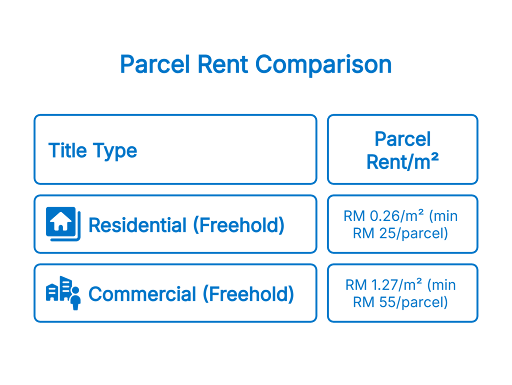
*Based on data from the Land and Mines Office (FT).
These higher costs for commercial parcels affect the ongoing monthly or annual expenses of serviced apartment owners.
Both electricity tariffs and government-linked taxes create a meaningful cost divide between condominiums and serviced apartments.
While the latter often offers superior convenience and strategic locations, buyers should account for potentially higher monthly outgoings to ensure the investment fits comfortably within their long-term financial plans.
Estimate instalments before deciding use the loan calculator.Market Trends & Insights for 2025/26
As Malaysia’s urban lifestyle and homeownership priorities continue to evolve, both serviced apartments and condominiums are adapting to new expectations around convenience, comfort, and long-term value.
Rising Appeal for Serviced Apartments
Here’s what is driving the rising preference among specific buyer and tenant groups:
- Urban property seekers, especially business travellers, expatriates, and long-stay tourists, increasingly prefer serviced residences for convenience and flexibility.
- Mixed-use developments remain popular, with serviced apartments integrated into towers that include retail, offices, or hotels.
- As hybrid work becomes more mainstream, more homebuyers see serviced apartments as a “live-work-play” option.
Condominium Stability and Long-Term Value
On the other hand, condominiums are maintaining strong traction for more traditional homeowners:
- Condominiums continue to be preferred by local families and long-term buyers due to stable demand, better legal protection, and lower ongoing costs.
- Resale value tends to be stronger for condominiums in mature residential areas or well-managed strata developments.
- Developers are launching condominium projects in suburban areas to cater to demand from families seeking more space.
Regulatory and Cost Pressures
Buyers and investors also need to account for cost sensitivity and policy changes:
- With TNB’s new tariff, the cost structure for electricity has changed significantly. There may be cost pressure on service apartment owners or renters, mainly due to capacity and network charges.
- Rising parcel rents and assessment rates for commercial parcels have pushed some developers and investors to re-evaluate the service apartment model.
- Demand for energy efficiency and smart meter usage is increasing, especially with the ToU tariff options now more widely accessible.
Overall, 2026 is shaping up to be a year when practicality guides decision-making, whether that means choosing the flexibility of serviced apartments or the long-term security and community feel of a well-managed condominium.
Popular Service Apartment & Condominium Projects in Malaysia
Here are some notable service apartment and condominium projects across major Malaysian cities:
Service Apartment Projects
| Project Name | Location | Completion Year | Unit Types |
| Majestic Residence | Jalan Sultan Ismail, KL | 2026 | One-two Bedrooms |
| Times Square 2 | Kuala Lumpur | 2027 | Studios-3BR |
| Khaya Residences | Bangsar, KL | 2029 | One-three Bedrooms |
| Parkside Residences @ Setia Federal Hill | Federal Hill, KL | 2030 | One-three Bedrooms |
| Temasya Prisma | Glenmarie, Selangor | 2026 | One-three Bedrooms |
Condominium Projects
| Project Name | Location | Completion Year | Unit Types |
| The Vividz | Bukit Jalil, KL | 2028 | One-three Bedrooms |
| The Maxxon | Cheras, Selangor | 2028 | Three-four Bedrooms |
| Platinum Melati Residences | Setapak, KL | 2028 | One-two Bedrooms |
| SJCC East One | Subang Jaya, Selangor | 2029 | Two-three Bedrooms |
| Jardin Residences Phase 2 | Sungai Buloh, Selangor | 2025 | Three-four Bedrooms |
From city-centric living to long-term residential comfort, the right property in 2026 is simply a matter of preference.
Which Option Is Best for Different Lifestyles
Choosing between a service apartment and a condominium often comes down to your personal or investment priorities:
- Frequent Movers or Corporate Users: If you relocate often or work in business hubs, a serviced apartment gives flexibility, convenience, and minimal commitment.
- Long-Term Residents: For long-term personal residence, a condominium offers cost stability, legal certainty, and a community environment.
- Investor Strategy: Use serviced apartments for short-term rental yield; use condominiums for stable, long-term capital growth.
- Cost-Sensitive Buyers: Condominiums tend to have lower monthly utility and administrative costs compared to serviced apartments.
- Lifestyle Seekers: If you value hotel-like amenities (cleaning, reception) or want a “lock-up and go” residence, serviced apartments suit you. If you value a community and long-term roots, a condo may feel more like home.
Ultimately, your ideal choice is the one that not only fits your budget and investment goals but genuinely complements the way you want to live, every single day.
Practical Tips When Buying or Renting
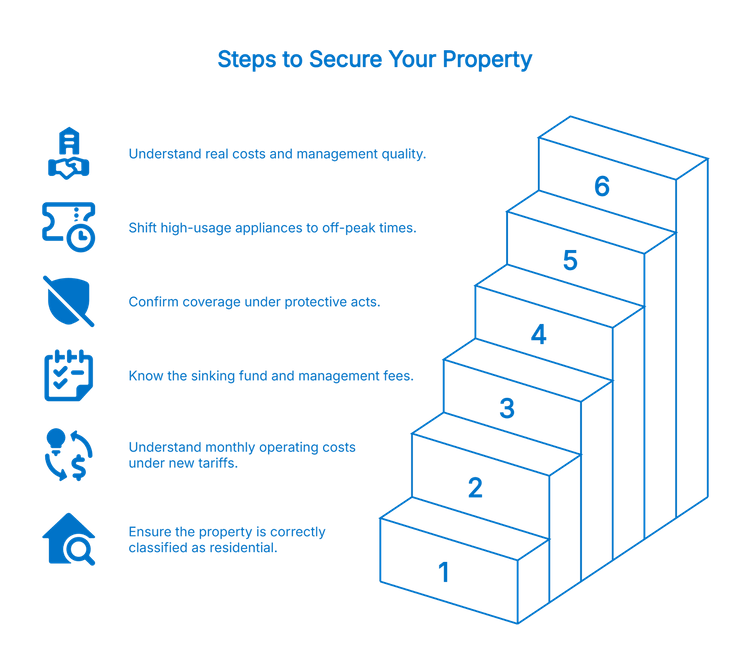
Before committing to a serviced apartment or condominium, it helps to go in with clear expectations and a complete understanding of costs, rights, and the quality of management.
Here are practical checks that can protect your finances and lifestyle:
- Verify the Land Title: Always check whether the serviced apartment or condo is titled as commercial or residential in the SPA or in the title deeds.
- Estimate Real Utility Costs: Request historical electricity and water bills from management to understand probable monthly operating costs under the new tariff structures.
- Review Maintenance and Service Fees: For condos, know the sinking fund and management fees. For service apartments, clarify which services are included (e.g., housekeeping, reception).
- Check Legal Guarantees: Confirm whether the unit is covered under the HDA or other protective acts; this affects resale and buyer safeguards.
- Use ToU Smart Meter Option: If you choose the ToU tariff from TNB, shift high-usage appliances (e.g., washing machine, EV charger) to off-peak times (10 pm-2 pm or weekends) to save on electricity.
- Talk to Existing Residents: Speak with occupants or neighbours to understand the real costs, behaviour, and the quality of management.
Done right, these checks can help you choose the property that not only fits your budget but genuinely supports the way you want to live.
What Should You Pick?
In comparing service apartments vs. condominiums, there is no one-size-fits-all answer. The right choice depends on your lifestyle, how long you plan to stay, and how much you value convenience over cost.
- Service Apartments: Ideal for flexibility, fully furnished living, and integrated lifestyle amenities, though with higher running costs.
- Condominiums: Better suited for long-term living, community-focused environments, and more predictable costs.
Ready to explore available condos and serviced apartments in Malaysia? Head to iProperty Malaysia to browse sales listings, filter by property type, and compare your preferred units side by side.