
Malaysia’s housing policies, like the 5-15% Bumiputera discount, aim to promote equitable homeownership but may unintentionally inflate demand for high-end properties, driving up prices and leading to poor resource allocation in the housing market.

Affordable housing remains a major concern in the country. This is reflected in the government’s allocation under Budget 2025: (i) RM900 million for the Program Residensi Rakyat (PRR) and Rumah Mesra Rakyat housing schemes to address the critical need for more affordable housing options and (ii) RM12.8 billion for the House Credit Guarantee Scheme (SJKP) to support 57,000 first-time buyers with limited financial history or lower incomes to qualify for home loans.
While many know that affordable housing (rumah mampu milik) is built with the aim of fulfilling the housing demand of the lower income groups, little knows that affordable shops (kedai mampu milik) and affordable factories (kilang mampu milik) are a government initiative to help small entrepreneurs with fewer financial resources to own their business premises so as to encourage the establishment of more start-ups and, thus, help boost domestic economic activities.
In Selangor, for example, the policy of imposing the building of affordable shops and factories has been officially introduced through the 1st edition of the Selangor Planning Guidelines and Standards Manual. This is applicable for the development of shops and factories on a development land larger than 10 acres or for development consisting of more than 50 units of shops or factories. Developers are required to provide 20% of their overall development of shops as affordable terrace shops, with a minimum lot size of 18’ x 60’ priced at RM120k (or RM111/ft2).
Likewise, 30% low-cost factories are required to be provided for developments with a minimum lot size of 20’ x 60’ priced at RM150k (or RM125/ft2). A similar policy is also found in Johor and Melaka, where 40% and 20% of affordable shops priced at RM200k are to be provided, respectively. Note that, at the time of writing this article, other states in Malaysia do not practise such a policy, and the author has yet to find a similar policy in other countries.
Well-Intentioned Policy, Unintended Consequences?

In principle, the provision of affordable shops and factories can be a useful means to achieve objectives that governments believe are economically or socially desirable: to encourage the development of small and medium enterprises (SMEs) to enhance social progress and increase job opportunities, as prosperous countries have small enterprise sectors that function well as an attraction factor for foreign direct investments (FDIs). In addition, the SME sector is critical to Malaysia’s aims of developing indigenous enterprises, promoting endogenous sources of growth, and strengthening the prospect for broad-based growth.
However, these affordable shops and factories can hardly meet the noble objective of the above. Most often, they are misused and profiteered by non-deserving and unethical buyers. These premises are either leased out by the owners at the market rental returns or to be sold at market prices once the 5-year moratorium on sale expires. While some of these premises are used for genuine business purposes by owners, most of them provide low value-added services such as workshops for car repair, car washing, electrical devices, furniture, etc., which are unlikely to constitute use or result in the creation of unique and valuable intangibles of the core business. Therefore, such a policy has little impact on improving the status quo of our SMEs.
To make matters worse, these affordable shops and factories create an unsustainable price distortion in the real estate market. This is because the viability of affordable shops and factories depends heavily on the cross-subsidization from free-market properties—just like the development of price-controlled affordable housing (Rumah Selangorku, Rumah WIP, Residensi Madani, etc.), where the actual development cost often exceeds the capped selling price set by the regulators.
As shown in Figure 1, the building cost alone for a single-storey shop house and link factory is estimated at RM100/ft2 and RM90/ft2, respectively. Together with the infrastructure cost (13 – 14%), land & land related cost (22 – 24%), soft cost (7 – 8%), compliance cost (4 – 5%), and preliminary & contingency cost (9 – 10%); the total development cost of the said shop house and link factory could end up at a price of RM145/ft2 and RM161/ft2, respectively; which is likely to exceed the capped selling price of RM111/ft2 and RM125/ft2.

At an unrealistic sale price of RM120,000 for affordable shops and RM150,000 for affordable factories, against a much higher development cost, the differences in cost will inevitably be borne by those who purchase free-priced commercial/industrial properties. This raises the question of equality and fairness: Should our general Rakyat subsidise entrepreneurs for the purchase of commercial/industrial properties, in the sense that some of these entrepreneurs could be profiteering at market rate rental and sub-sale?
In fact, entrepreneurs with lesser financial resources should rent their premises first. They should be conserving their cash flow and investing in raising their business instead of owning property. More importantly, encouraging the ownership of premises is not really helping the growth of our SMEs. Especially during the recovery stage in the post-pandemic era, where many SMEs are unable to recruit, reverse employee pay cuts, or even pay for raw materials to resume operations as they have been dealing with cash flow crunches.
Should the government aim to boost SMEs, improving sluggish productivity through integrating and transferring proven practices and technologies is a worthwhile endeavour. Banks and the financial sector should also be emphasised to play a much bigger role in preparing SMEs for commercialisation, offering much-needed expert advice and special transfer facilities to ensure capital investment and accelerate technology upgrades and transfer.
Realising that giving subsidies to someone will often disadvantage others who do not receive such subsidies, thereby distorting investment and other economic activity, a deeper consideration should be given to whether such policy should be continued, refined, or abolished.

How does Bumiputera blanket discount inflate high-end property demands?
Conventional housing policies like giving a blanket discount of between 5% and 15% to every Bumiputera house buyer have shown that not only undermine the policy’s original goal of promoting equitable homeownership among the lower-income community that historically faced economic disadvantages but also tend to inflate demand for higher-end properties, which then leads to overpricing in the housing market as well as contributing towards a poor resource allocation.
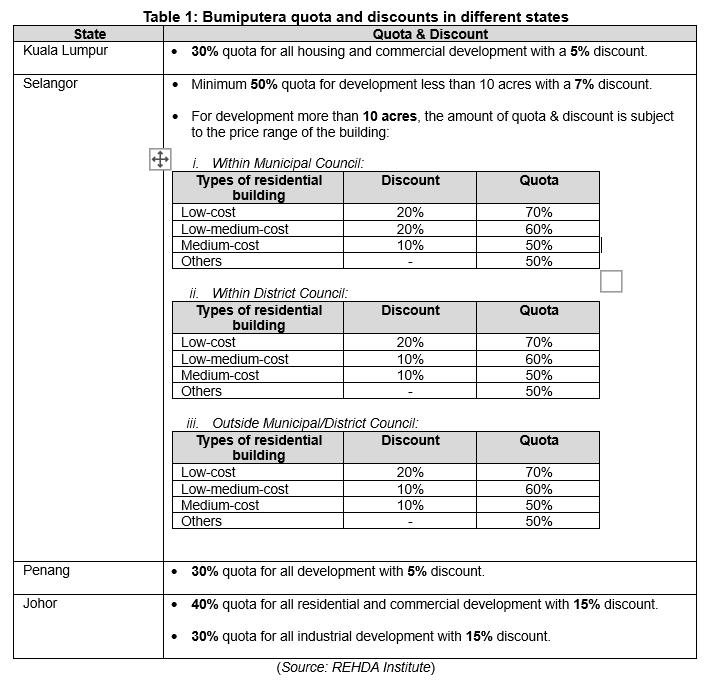
For example, in Kuala Lumpur, a 5% discount on a 30% Bumiputera quota can effectively translate to about 1.5% of GDV cross-funding by the open-market segment, where open-market buyers are paying higher prices to share out the cross-subsidy that enables such Bumiputera discount to be in place. The Bumiputera quotas and discounts for other states are shown in Table 1. One can see that, except for Selangor, where the Bumiputera discounts are based on building types for developments of more than 10 acres, a blanket discount is imposed in other states regardless of the type and size of developments and the buyer’s income profile.
Since the discounts are provided across the board and not categorised by ceiling pricing, it is not really a targeted policy to assist those who need help with home ownership and is unfair to open market purchases, as Bumiputera buyers of higher-end properties, for example, RM1 million and above would still be given the Bumiputera discounts. These buyers are likely to have high purchasing power and should not be getting cross-subsidized discounted prices at the expense of other buyers. Instead, they should be excluded from receiving such discounts as they crowd out other deserving families from their community.
More importantly, the industry’s main concern on the issue of Bumiputera quota and discount is more in cases where quota units remain unsold. Quota units not sold do not get a fast release for sale in the open market. Approval for release application is subject to various eligibility criteria and is approved only in stages. There are no standard release mechanisms, and release, if any, depends on the respective state’s policies, where developers may be charged with a levy for the release of such unsold units. The approval for release, however, is not transparent and automatic, and developers are not guaranteed full release over a specific period. This mechanism creates uncertainty and adversely affects project marketing and cash flow planning.
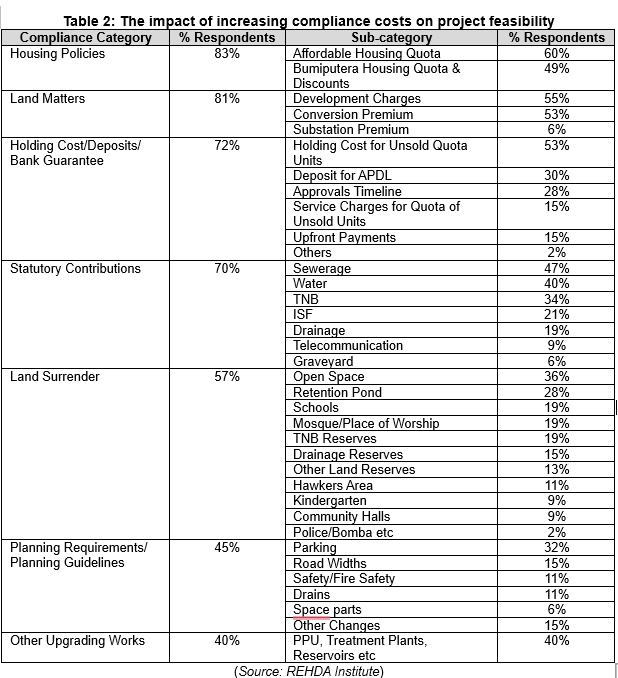
Based on a study conducted by the REHDA Institute, 83% of the survey respondents perceived that “housing policies” are the major root cause of increasing challenges to a project’s viability. Within this “compliance category,” affordable housing quota and the Bumiputera housing quota and discounts are the two biggest concerns among survey respondents (Table 2).
Though the study did not cover the impact of state governments’ mandatory in building affordable shops and factories, one should realise that any form of cross-subsidization in property development is not sustainable, as the price of open market housing units can only be adjusted upwards in uptrend market condition and is restricted by market demand. Ultimately leading to unintended benefits for wealthy individuals who should not benefit from such support.
Realising that the Malaysian housing industry is heavily regulated by legislative hurdles, which further deviate the housing market from a balanced supply and demand system, refining the subsidy policy becomes necessary. This will ensure it is more targeted while reducing the risk of worsening wealth inequality within the community.
What is more, to align with Budget 2025 themed “Reinvigorating the Economy, Driving Reforms, and Prospering the People,” the government should set forth a transformation journey for subsidy reform to reshape the incentive structures to deliver the eventual outcomes. This is deemed necessary not only to protect vulnerable groups by redirecting a part of the savings towards targeted assistance programmes but is also equally important for the government to balance between ensuring long-term fiscal sustainability and allocating resources more effectively. All in all, this will require political leadership to affect the necessary push anchored by a set of strategic policy initiatives.