

With rising living costs, housing repayments, and everyday expenses, even households earning a five-figure monthly income may struggle to determine where they stand financially. Does earning RM10,000 a month qualify you as T20 in Malaysia, or is the income threshold higher?
The T20 category represents Malaysia’s top 20% of households by income. However, belonging to this group does not necessarily mean a household is wealthy, as financial commitments, dependants, and living expenses can significantly affect disposable income.
According to the latest Department of Statistics Malaysia (DOSM) Household Income Survey 2024, T20 households earn at least RM12,680 in gross monthly household income. This guide explains the latest T20 Malaysia income thresholds, how they compare with B40 and M40, and what being in the T20 group means for homebuyers in 2026.
Check your estimated monthly repayments with the Mortgage Calculator.What Is T20 In Malaysia?
T20 stands for the Top 20%, referring to the highest-earning 20% of Malaysian households. It is an income classification based on the national household income distribution rather than an individual’s salary or accumulated wealth.
Malaysia’s households are commonly divided into three categories:
- B40 (Bottom 40%): The lowest-income 40% of households.
- M40 (Middle 40%): The middle-income 40% of households.
- T20 (Top 20%): The highest-income 20% of households.
According to DOSM’s Household Income Survey Report 2024, approximately 1.64 million Malaysian households belonged to the T20 category, accounting for 45.1% of the country’s total household income. This highlights the significant share of household income concentrated among the highest-earning 20%.
These classifications help illustrate income differences across Malaysia, although they do not directly measure household wealth or financial security.
What Is the T20 Income Threshold in Malaysia in 2026?

The T20 income threshold in Malaysia starts at RM12,680 per month, based on the latest official 2024 household income data released in October 2025.
The threshold increased from RM11,820 in 2022, reflecting changes in Malaysia’s household income distribution. Importantly, RM12,680 represents gross monthly household income, not the minimum salary one individual must earn.
For example, a husband earning RM7,000 and a wife earning RM6,000 have a combined household income of RM13,000. This places their household in the national T20 category, even though neither earns RM12,680 individually.
These are national thresholds. Individual states have different income distributions, which means the amount needed to enter the local T20 group can vary considerably.
How Does T20 Income Compare With B40 And M40 In Malaysia?
To better understand where T20 households stand, it is useful to compare their earnings with Malaysia’s other household income groups. Based on the latest DOSM Household Income Survey 2024, the national income thresholds are as follows:
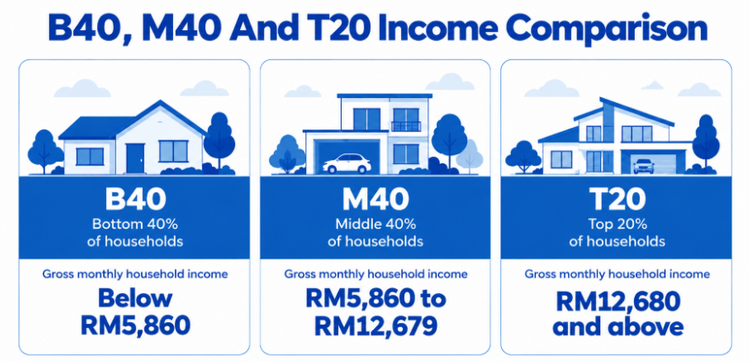
The comparison shows that households earning RM12,680 or more belong to the national T20 category, while those earning slightly below this threshold remain within M40. However, these classifications reflect gross household income rather than disposable income, so households within the same group may have different financial commitments and spending capacity.
Browse new homes for sale in Malaysia and find one that fits your needs.How Is T20 Household Income Calculated?
To determine whether you belong to T20, calculate the combined gross monthly income received by members of your household.
DOSM’s household income definition includes employment earnings, self-employment income, property and investment income, and current transfers received.
Consider this example:
| Income source | Monthly amount |
| Husband’s salary | RM8,000 |
| Wife’s salary | RM5,000 |
| Rental income | RM1,500 |
| Total household income | RM14,500 |
With RM14,500 in gross monthly income, this household qualifies as T20 nationally.
Gross income is measured before deductions such as Employees Provident Fund (EPF) contributions and income tax. Therefore, your take-home pay may be lower than the income used to determine your classification.
How Does Household Size Affect T20 Classification In Malaysia?
T20 classification in Malaysia is based on total household income rather than the number of people living in a household. This means two households earning RM15,000 monthly may both qualify as T20, even if one consists of two adults and the other includes several children and elderly dependants.
Household size can influence how far that income stretches. For example:
- Two-person household: A couple earning RM15,000 monthly may have fewer expenses if they have no dependants.
- Four-person household: A family earning the same amount may need to allocate more money towards childcare, education, and daily necessities.
- Multigenerational household: A household supporting elderly parents and children may have additional healthcare and living expenses.
Although all three households fall within the national T20 category, their disposable income and purchasing power may differ considerably.
This is particularly relevant when buying a property, as larger households may require additional bedrooms, more living space, and access to schools or healthcare facilities. Therefore, household size should be considered alongside income when assessing housing needs and affordability.
What Are The T20 Income Thresholds Across Malaysian States?
The amount required to enter the T20 group varies depending on where a household lives. DOSM’s 2024 survey provides separate income thresholds for each state and Federal Territory.
| State / Federal Territory | Monthly T20 threshold |
| Putrajaya | RM19,030 |
| Kuala Lumpur | RM17,030 |
| Selangor | RM16,040 |
| Johor | RM13,560 |
| Pulau Pinang | RM12,680 |
| Melaka | RM11,560 |
| Negeri Sembilan | RM9,980 |
| Sabah | RM9,160 |
| Perak | RM8,220 |
| Kelantan | RM7,000 |
For example, a household earning RM15,000 monthly qualifies as T20 nationally but falls below Kuala Lumpur’s local T20 threshold of RM17,030.
This difference is important when comparing household income and housing affordability across Malaysian states.
Does Being In The T20 Group Mean You Are Rich?

Not necessarily. Although T20 households earn more than 80% of Malaysian households, income alone does not determine financial wealth.
Several factors influence their financial position:
- Location: Housing and living expenses may be higher in Kuala Lumpur or Selangor than in smaller towns.
- Dependants: Families supporting children, elderly parents, or other dependants may have higher monthly commitments.
- Existing debts: Home loans, car loans, and personal loans can reduce disposable income.
- Assets and savings: Two households earning the same income may have very different levels of accumulated wealth.
For example, a T20 household earning RM14,000 monthly may still face financial pressure if a substantial portion goes towards mortgage repayments, childcare, and other commitments.
Therefore, T20 status indicates a household’s position in the income distribution, not necessarily its overall financial security.
Find properties for sale in Malaysia and compare available homes.Can T20 Households Afford More Expensive Properties?
T20 households may have greater borrowing capacity because of their higher earnings. However, qualifying as T20 in Malaysia does not automatically guarantee home loan approval.
Banks generally consider several factors when assessing mortgage applications:
- Debt Service Ratio (DSR): The proportion of monthly income used to repay existing debts.
- Credit history: Previous repayment behaviour and outstanding financial commitments.
- Down payment: Savings available for the property’s initial purchase costs.
- Monthly expenses: Financial obligations that affect repayment affordability.
For example, a T20 household with RM15,000 monthly income and substantial existing debts may have less borrowing capacity than a household with lower earnings but fewer commitments.
Before purchasing a property, buyers should calculate their expected repayments and consider expenses such as stamp duty, legal fees, maintenance charges, and insurance.
What Property Options Can T20 Households Consider In Malaysia?
T20 households in Malaysia may have access to a wider range of residential properties due to their higher combined income. However, the type of property they can afford depends on their savings, existing financial commitments, preferred location, and home loan eligibility.
Depending on their budget and housing needs, T20 households may consider:
- Condominiums: High-rise residential properties with shared facilities such as swimming pools, gyms, security services, and covered parking.
- Terraced houses: Landed properties that may offer additional living space, multiple bedrooms, and private parking.
- Semi-detached houses: Properties with larger built-up areas and outdoor spaces, which may suit households looking for more privacy.
- Bungalows: Detached homes that generally provide more space and privacy but may involve higher purchase prices and maintenance costs.
- Investment properties: Residential units purchased for rental income or potential capital appreciation, subject to market conditions and financing costs.
While T20 households may have more property choices, higher income does not automatically translate into greater affordability. Buyers should compare property prices, monthly repayments, maintenance expenses, and long-term financial commitments before deciding which property best suits their needs.
Will Malaysia Replace The T20 Income Classification?
The Malaysian Government is considering a Net Disposable Income (NDI) approach to better reflect households’ actual financial circumstances.
Unlike gross income classifications, NDI considers statutory deductions and essential living expenses, including differences in household size and location.
However, as of July 2026, the Government continued using B40, M40, and T20 for socioeconomic analysis and assistance-related purposes while studying possible improvements.
Until an alternative framework is officially implemented, the latest DOSM income thresholds remain the appropriate statistical reference.
Understanding Your T20 Status Before Buying A Home
Knowing whether you belong to T20 Malaysia can help you assess your household’s income position, but it should not be the only consideration when buying a property.
A sustainable home purchase depends on your disposable income, existing debts, savings, and long-term financial commitments. Rather than choosing a property based on your income classification, focus on what your household can comfortably afford.
Looking for the latest trends shaping Malaysia’s property market? Get market updates and useful insights with Property Insights on iProperty Malaysia.