
Buying a landed property in Malaysia can be a major decision, especially when you are unsure which house type offers the right balance of space, privacy and cost. You may be considering a semi-D house but still have questions about how it compares with other landed homes and whether the higher price is justified.
A semi-D house, short for semi-detached house, offers more space and privacy than a typical terrace house while generally costing less than a fully detached property. This makes it a good option for you as a buyer if you want the benefits of landed living without choosing a fully detached home.
This guide covers what a semi-D house is, how it compares with other landed homes, its pros and cons, investment potential, costs, and where to find one for sale in Malaysia.
<a href=”https://www.iproperty.com.my/guides/home-finance”><strong>Explore our Home Financing Guides for confident property planning.</strong></a>What is a semi-D house?
A semi-D house shares one common wall with a single neighbouring unit. Unlike a terrace house, it is attached on only one side, giving you a strip of land along the other side that you can walk through from front to back without entering the house.
This design has evolved over the years. While semi-D traditionally referred to landed homes with individual titles, you’ll now also come across terms like semi-D cluster (within a gated and guarded community, usually with a strata title) and semi-D condo or “semi-D in the sky” (a high-rise unit attached to just one neighbour, offering more privacy).
How is a semi-D house different from a terrace house or a fully detached house?
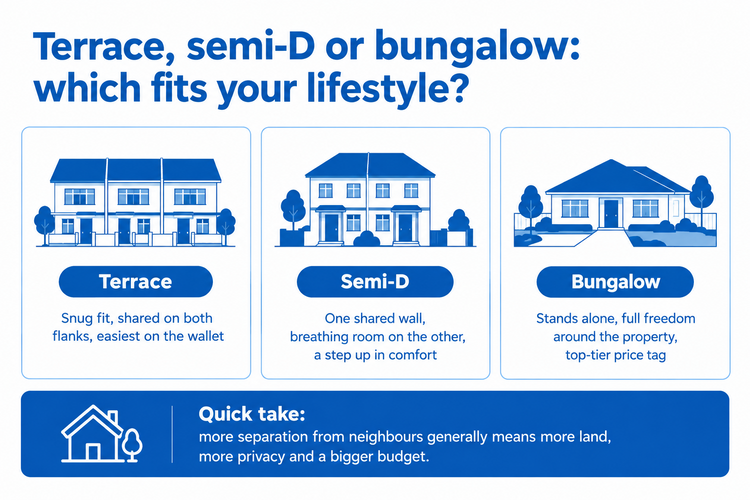
A semi-D house shares one wall with a single neighbour, unlike a terrace house, which is attached on both sides, or a detached house, which stands on its own. These differences affect space, privacy, maintenance, and price.
| Aspect | Terrace house | Semi-D house | Detached house (bungalow) |
| Attachment to neighbours | Shares walls on both sides. | Shares one wall with a neighbour. | Does not share any walls. |
| Land around the house | Usually has limited side space. | Has open space on one side. | Has open space around the house. |
| Privacy | Offers less privacy. | Offers more privacy than a terrace. | Usually offers the most privacy. |
| Access around the property | Access is mainly through the front or back. | Open side allows easier access around the house. | Open space allows access around the house. |
| Neighbour noise | May come from both sides. | Usually comes from one side. | Less direct noise from attached neighbours. |
| Renovation considerations | Changes may affect two adjoining properties. | Changes may affect one adjoining property. | More flexibility with no shared wall. |
| Upkeep and maintenance | Generally easier to maintain. | Requires more upkeep than a terrace. | Usually requires the most upkeep. |
| Typical price | Generally more affordable. | Usually costs more than a terrace. | Usually the most expensive option. |
Who may a semi-D house suit?
A semi-D may suit you if you want more privacy, outdoor space and the feel of landed living. It can work well if you need extra room for your family, entertaining or future changes to the home.
You may want to think twice if you have a tighter budget or prefer a lower-maintenance property. The larger space can also mean higher upkeep and purchase costs compared with some other landed or non-landed options.
What are the pros and cons of buying a semi-D house?
A semi-D house can offer a balance of space, privacy, and value, but it also comes with higher costs and some limitations. Here’s a clear breakdown of what you can gain and what to consider before buying one.
Pros of buying a semi-D house
- More outdoor space. The open side gives you additional land for gardening, outdoor activities, an alfresco area or extra parking, depending on the property’s layout.
- Better privacy than a terrace house. With only one shared wall, you have fewer adjoining neighbours, which can reduce direct noise and provide a greater sense of separation.
- More space for families. Semi-D houses often offer larger indoor layouts, giving growing families more room for bedrooms, living areas, storage, and everyday activities.
- More natural light and ventilation. The open side can allow more sunlight and airflow into the property, particularly for rooms positioned along the side of the house.
- Potential for future improvements. The additional land may provide more scope for extensions, landscaping or layout changes, subject to planning requirements and relevant approvals.
- Strong buyer appeal. Semi-D homes can appeal to buyers seeking more space and privacy than a terrace house without the higher cost of a fully detached property.
Cons of buying a semi-D house
- Higher maintenance costs. A larger home and additional outdoor space can require more cleaning, landscaping, repairs, and regular upkeep than a smaller terrace property.
- Higher upfront cost. Semi-D houses generally cost more than comparable terrace homes, which can make them less suitable for buyers working with a tighter purchasing budget.
- Still shares one wall. Although a semi-D offers more separation than a terrace house, you still share a wall with one neighbour and may experience some noise.
- Renovations can be expensive. Larger spaces and potential extensions may require a bigger renovation budget, while structural changes may also need professional advice and relevant approvals.
- Limited availability. Semi-D houses are less common than terrace properties in many locations, so buyers may have fewer choices in their preferred neighbourhood or price range.
- Higher ongoing expenses. A larger property can mean higher utility bills, repair costs, security expenses, and landscaping requirements, depending on its size and condition.
A semi-D house offers a good middle ground between space, privacy, and cost, making it a solid choice for families looking to upgrade without going all the way to a bungalow. Weigh the higher maintenance and lower rental yields against your priorities before deciding.
<a href=”https://www.iproperty.com.my/semi-d-for-sale”><strong>Browse semi-detached houses for sale in Malaysia and find your ideal home.</strong></a>Is a semi-D house a good investment in Malaysia?
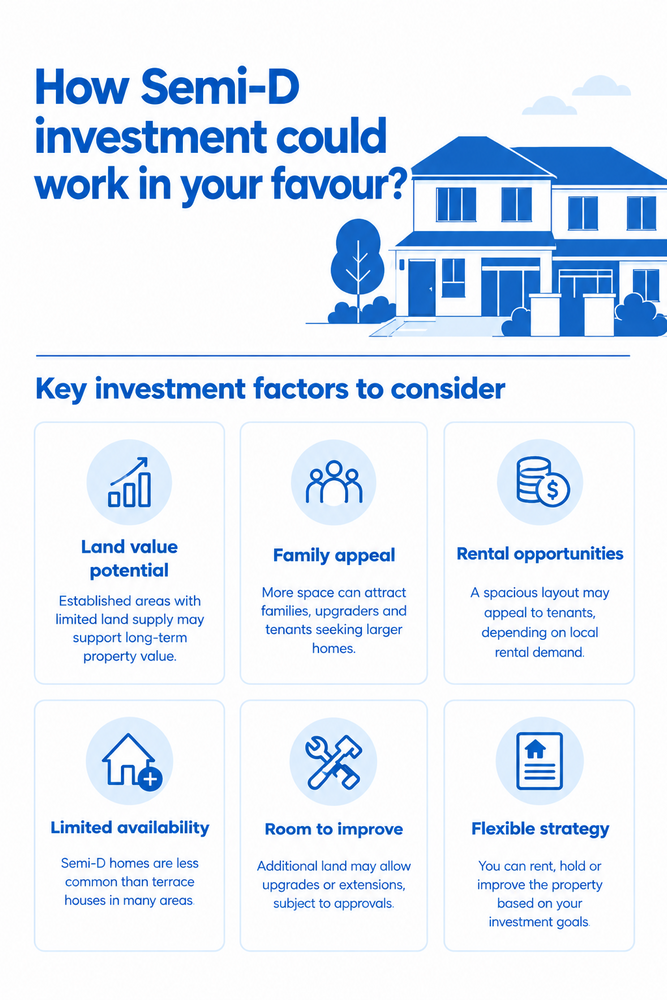
A semi-D house can be a worthwhile investment, especially in established areas with steady demand for landed homes. However, its investment potential depends on factors such as location, purchase price, rental demand, property condition, and wider market conditions.
Potential advantages for investors
- Potential for capital appreciation. Semi-D properties in established neighbourhoods may benefit from rising land values, particularly where demand for landed homes remains strong and available land is limited.
- Appeal to family buyers. Larger layouts and additional outdoor space can attract families and upgraders, which may help maintain buyer interest when you eventually decide to sell.
- Potential rental demand. Spacious semi-D homes may appeal to families and tenants looking for more living space, although rental demand and achievable rent can vary significantly by location.
- Limited supply. Semi-D homes are generally less common than terrace houses, so properties in established areas with limited new supply may have stronger long-term appeal.
- Scope for improvements. Additional land may provide opportunities for landscaping, extensions, or other upgrades, subject to planning rules and approvals, which could improve the property’s appeal.
- Flexible investment approach. Investors can rent out the property for income (I.e property investment), hold it for potential long-term appreciation, or improve it before selling, depending on their investment strategy.
Is it right for you?
A semi-D house may suit you as an investor if you’re looking for a landed property with space and long-term potential. Before committing, compare the purchase price, expected rental income, maintenance costs, and local demand.
<a href=”https://www.iproperty.com.my/financing/mortgage-calculator/”><strong>Use the Mortgage Calculator to estimate your monthly repayments. </strong></a>How much does a semi-D house cost in Malaysia?
A semi-D’s price can vary based on location, land size, built-up area, property age, condition, and nearby amenities. Local demand and current market conditions can also influence the asking price. A national average of around RM507,533 provides a general reference, but prices can range from more affordable homes in smaller towns to several million ringgit in prime locations.
- Location strongly affects price. Semi-D houses in Kuala Lumpur can cost around RM2.51 million on average (estimated).
- Smaller towns can offer lower prices. Semi-D houses priced below RM1 million (estimated) are more common in less central areas, giving buyers more affordable options outside major cities.
- Prime neighbourhoods cost more. Areas such as Mont Kiara, Taman Tun Dr Ismail and Desa Sri Hartamas can have semi-D houses priced at RM2 million or more (estimated), with larger or newer properties reaching RM4 million to RM5 million.
- Land and built-up size affect the price. A larger semi-D with more land or built-up space will generally cost more than a smaller property, even within the same neighbourhood.
- Age and condition also matter. Older semi-D houses may have lower asking prices than newer properties, but buyers should account for potential renovation and repair costs.
Semi-D house prices in Malaysia vary widely, so buyers should compare properties based on location, size, condition, and budget. Checking recent listings in the area can help you understand whether the asking price is reasonable.
Where can you find semi-D houses for sale?
Finding the right semi-D house comes down to knowing where to look, and property portals make it far easier to compare options across locations, prices and sizes without relying on word of mouth or physical viewings alone.
- Property portals give you the widest selection. Platforms like iProperty let you filter listings by property type, price range, location and built-up area, so you can narrow down semi-D options that match your budget and needs.
- Verified agent listings add a layer of trust. Most portals, including iProperty, work with verified agents, which helps reduce the risk of scams or outdated listings when you’re browsing online.
- Useful tools beyond just listings. iProperty also offers a mortgage calculator and home loan eligibility tool, so you can check affordability before you start shortlisting properties.
- New launches and subsale units in one place. Whether you’re after a brand-new semi-D development or a resale unit in an established neighbourhood, portals typically list both, making comparison easier.
- Local classifieds and agent networks are worth checking too. Sites like Mudah and PropSocial, along with direct outreach to local real estate agents, can surface listings that aren’t always on the bigger portals, especially in smaller towns.
If you’re ready to start browsing, iProperty’s property-for-sale listings are a solid place to begin, since it covers a wide range of locations and price points across Malaysia.