

Owning a strata property in Malaysia comes with costs beyond your home loan, utilities, and property taxes. One recurring cost is the maintenance fee, which helps pay for the day-to-day management and upkeep of common property within a development.
For condominium, apartment, serviced apartment, and other strata property owners, understanding how this fee works is important before buying a home. The amount you pay can vary considerably between developments depending on their operating costs, facilities, density, and the share units allocated to your parcel.
Knowing what these charges cover can help you estimate the ongoing cost of owning a strata property and avoid unexpected expenses after your purchase. In this guide, we explain how maintenance fees in Malaysia work, how they are calculated, how they differ from sinking funds, and what can happen when payments fall into arrears.
Explore condominiums for sale in Malaysia and discover your ideal home.What Is A Maintenance Fee In Malaysia?
A maintenance fee, also known as a service charge, is a recurring payment collected from strata owners to cover the cost of managing and maintaining common property within a development.
These costs typically relate to shared areas and facilities such as lifts, corridors, swimming pools, gyms, gardens, guardhouses, and driveways. What the fee covers can vary depending on the facilities and services provided by the development.
The Strata Management Act 2013 (SMA 2013) provides the legal framework for collecting Charges and sinking fund contributions. Depending on the development’s management stage, payments may be collected by the developer, Joint Management Body (JMB), or Management Corporation (MC).
What Do Maintenance Fees Cover?
The maintenance fee is generally used for recurring expenses involved in operating and maintaining the development and its common property.
Depending on the development, these expenses may include:
- Security services
- Cleaning of common areas
- Property management and administration
- Electricity and water for common property
- Lift and escalator servicing
- Landscaping
- Swimming pool and gym maintenance
- Minor repairs to common property
- Building insurance
- Maintenance of shared equipment and systems
- Professional, audit, and administrative expenses where applicable
The exact expenses differ between developments. A property with multiple lifts, extensive landscaping, larger common areas, or numerous facilities may have different operating costs from a development with fewer shared amenities.
What Is The Difference Between Maintenance Fee And Sinking Fund?
Although both are contributions associated with managing a strata property, the maintenance fee and sinking fund serve different purposes.
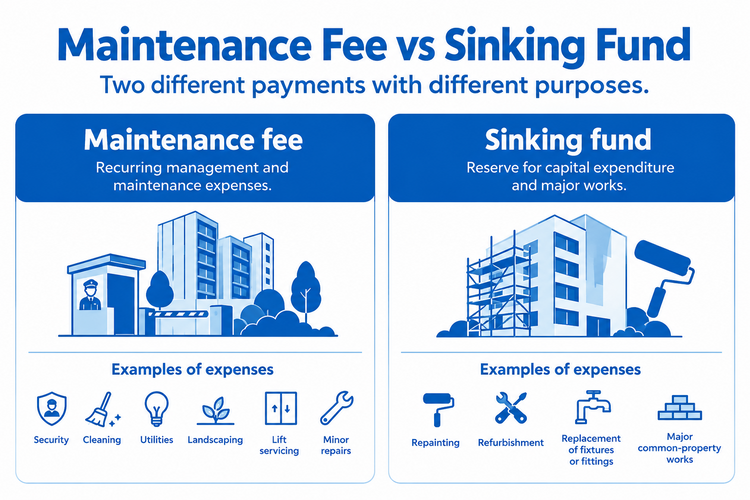
The sinking fund therefore provides money for expenditure that may be less frequent but more substantial than normal day-to-day maintenance.
Under the SMA 2013, the contribution to the sinking fund is generally a sum equivalent to 10% of the Charges at the relevant statutory stages. The applicable management body may determine a higher contribution in accordance with the Act.
For example, if the applicable maintenance charge for your parcel is RM300 a month and the sinking fund contribution is 10%, another RM30 would be payable to the sinking fund, bringing these two payments to RM330.
What Are Share Units And Why Do They Matter?

Share units are numbers allocated to individual parcels within a strata scheme and are used to determine each owner’s share of maintenance charges and sinking fund contributions. They are not necessarily based on floor area alone, as other prescribed factors relating to the parcel and accessory parcels may also apply.
This means two units of a similar size may have different maintenance obligations. Buyers should check the share units allocated to a property and understand how they affect ongoing charges. The Schedule of Parcels can also help buyers identify the proposed share units, parcels, accessory parcels, and common property within the development.
How Is The Maintenance Fee Calculated In Malaysia?
One important point for strata owners is that maintenance charges under the current strata framework are linked to share units, rather than simply charging every owner the same amount.
A simplified way of understanding the calculation is:
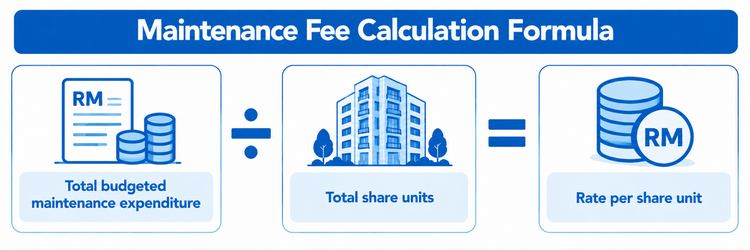
The amount attributable to an individual parcel can then be determined using the number of share units assigned to that parcel.
For example, suppose a development needs RM60,000 a month for its maintenance and management expenses and has 12,000 total share units.
RM60,000 ÷ 12,000 = RM5 per share unit
If a particular parcel has 80 share units:
RM5 × 80 = RM400
The parcel’s maintenance charge would therefore be RM400 for that period, before adding the applicable sinking fund contribution.
This is a simplified illustration. Owners should refer to the actual budget, share units, notices, and records issued for their development.
Calculate your estimated monthly repayments with the Mortgage Calculator.What Affects The Maintenance Fee You Pay?
There is no single maintenance fee that applies to every strata development in Malaysia. The amount depends on the expenditure required to manage the particular property and how those costs are apportioned.
Several factors can influence the overall cost:
- Facilities: Swimming pools, gyms, clubhouses, lifts, water features, and other facilities require regular servicing and maintenance.
- Security: The number of guards, access-control systems, CCTV systems, and security arrangements can affect operating expenditure.
- Development Density: A development with more parcels may spread certain shared expenses across a larger number of owners.
- Common Property: Extensive landscaping, large common areas, multiple blocks, and complex shared infrastructure can increase upkeep requirements.
- Age And Condition: Older developments may require more frequent repairs and maintenance of shared equipment.
- Service Standards: Cleaning frequency, security arrangements, landscaping requirements, and other service levels affect expenditure.
- Management And Service Contracts: The costs of contractors, property management, utilities, insurance, and other recurring services contribute to the budget.
For buyers, looking only at the advertised rate may therefore provide an incomplete picture. It is useful to understand what facilities and services the fee supports and whether the development has sufficient funds for ongoing maintenance.
How Much Is A Typical Maintenance Fee In Malaysia?

There is no statutory standard maintenance rate that applies to all strata properties in Malaysia.
You may see maintenance charges advertised on a psf basis when comparing developments, but the amount payable under the strata management framework should be considered alongside the parcel’s allocated share units and the development’s approved expenditure.
Rather than assuming that a particular psf figure is “cheap” or “expensive”, buyers can ask for information such as:
- The current maintenance charge
- The sinking fund contribution
- The parcel’s allocated share units
- Recent changes in charges
- Facilities included in the development
- The latest available management accounts
- Whether there are significant arrears among owners
- Planned major repairs or refurbishment
A low maintenance fee is not necessarily an advantage if it is insufficient to maintain the common property properly.
Can Maintenance Fees Be Increased?
Maintenance fees are not necessarily fixed for the entire period you own a strata property.
The amount required to operate a development can change as electricity, security, cleaning, insurance, repairs, staffing, and other expenses change. The applicable management body may therefore need to review the charges in accordance with the SMA 2013.
Owners should pay attention to notices, budgets, accounts, and resolutions presented at general meetings. Attending the Annual General Meeting (AGM) also gives owners an opportunity to understand the development’s financial position and how money is being spent.
Can You Dispute A Maintenance Fee?
An individual owner generally cannot negotiate a separate maintenance rate, as charges are imposed under the strata management framework. However, owners who believe a charge or management decision is improper can raise the matter with the developer, JMB, MC, or Commissioner of Buildings (COB).
Certain disputes may also be brought before the Strata Management Tribunal, which can hear specified claims involving maintenance charges and sinking fund contributions under the Strata Management Act 2013. Its monetary jurisdiction is up to RM250,000, so owners should keep relevant notices, statements, receipts, and correspondence to support their case.
Browse properties for sale in Malaysia and find one that suits your needs.What Happens If You Do Not Pay Maintenance Fees?
Maintenance fees and sinking fund contributions are not optional for strata owners. If payments fall into arrears, several consequences may follow:
- Interest may be charged on the outstanding amount.
- A formal demand may be issued requiring the arrears to be paid.
- Recovery action may be taken by the relevant management body.
- A claim may be filed with the Strata Management Tribunal to recover unpaid Charges or sinking fund contributions.
- The development’s finances may be affected, leaving less money for security, cleaning, lift servicing, utilities, and repairs.
If you believe an outstanding charge is incorrect, check your statement and raise the issue promptly with the management rather than ignoring the demand.
Who Pays Maintenance Fees For A Rental Property?
For a strata property that is rented out, the statutory obligation to the relevant management body generally rests with the parcel owner.
A landlord and tenant may separately agree in their tenancy agreement on how certain property expenses will be handled. For example, the rent may be structured to account for the maintenance fee, or the agreement may contain specific provisions regarding payments.
However, a private arrangement between landlord and tenant does not by itself remove the owner’s obligations to the strata management body.
Both parties should therefore check the tenancy agreement carefully so there is no confusion over rent, maintenance-related payments, utilities, and repairs.
What Should Buyers Check About Maintenance Fees Before Buying?
Maintenance fees are part of the ongoing cost of owning a strata property. Before buying, understand what you will need to pay and whether the development appears well maintained and financially managed.
- Current maintenance fee: Check how much you will need to pay regularly.
- Sinking fund contribution: Find out the additional amount payable for future major works.
- Share units: Confirm the share units allocated to the parcel, as these affect your contributions.
- Outstanding charges: For a subsale property, check for any unpaid charges.
- Facilities: Consider whether the amenities justify the ongoing costs.
- Common property condition: Check how well shared areas and facilities are maintained.
- Management and finances: Review available records to understand how funds are managed.
Looking beyond the monthly fee can give you a better picture of the property’s ongoing costs and whether sufficient funds are available for maintenance and future works.
Maintenance Fees Are Part Of The Cost Of Strata Ownership
The maintenance fee is more than another monthly bill. It contributes to the security, cleaning, utilities, servicing, management, and upkeep required to keep common property functioning.
For buyers, comparing maintenance charges before purchasing a strata property can provide a clearer picture of the property’s ongoing ownership costs. Check the share units, sinking fund contribution, facilities, management records, and current charges rather than comparing properties solely on purchase price.
For existing owners, staying informed about budgets, accounts, general meetings, and planned expenditure can make it easier to understand where your contributions go and why the amount may change over time.
Want to stay informed about Malaysia’s property market? Get the latest property trends and market updates with Property Insights on iProperty Malaysia.