

If you own or live in a strata property in Malaysia, you may have come across terms such as Joint Management Body (JMB), Joint Management Committee (JMC), Management Corporation (MC), and Subsidiary Management Corporation (Sub-MC).
These bodies and committees play different roles in managing strata developments, including maintaining common property, collecting maintenance charges, managing sinking funds, enforcing by-laws, and arranging repairs.
However, a JMB and a joint management committee are not the same thing. Understanding the difference, and when an MC or Sub-MC takes over certain responsibilities, can help parcel owners know who manages their development and whom to approach when an issue arises.
What Is A Joint Management Committee?
The joint management committee, commonly abbreviated as JMC, is the committee elected by the JMB to conduct its business and perform its duties on its behalf.
Under Section 22 of the Strata Management Act 2013 (SMA), the JMC may exercise the powers of the JMB, subject to any restrictions or directions imposed by the JMB at a general meeting.
Generally, the committee consists of between three and 14 natural persons, with the number determined at a general meeting. The developer is also represented on the committee.
What Are The Duties And Responsibilities Of A JMC?
The joint management committee (JMC) conducts the business of the Joint Management Body (JMB) and performs its duties on its behalf. Its responsibilities generally include:
- Overseeing common property: Helping ensure shared areas and facilities are properly maintained and managed.
- Managing day-to-day operations: Overseeing matters such as cleaning, security, waste collection, lift maintenance, and repairs.
- Managing finances: Overseeing expenditure, maintenance charges, sinking fund contributions, and other financial matters handled by the JMB.
- Implementing by-laws: Helping ensure applicable by-laws and additional by-laws are followed within the development.
- Arranging maintenance and services: Coordinating contractors and service providers required for the management of common property.
- Carrying out JMB decisions: Implementing decisions made by the JMB at general meetings.
The JMC does not operate as a separate management body from the JMB. Under Section 22 of the Strata Management Act 2013, it acts on the JMB’s behalf and remains subject to any restrictions or directions imposed by the JMB at a general meeting.
Who Can Become A JMC Member In Malaysia?
A person must generally be at least 21 years old to be elected to the joint management committee (JMC). Eligible candidates can include:
- A parcel owner or co-owner of a parcel.
- A nominee of a company or other body that owns a parcel, such as a society or statutory body.
- An immediate family member of a parcel owner who owns two or more parcels, provided that the owner nominates them.
A proxy appointed by a parcel owner cannot be elected to the JMC simply because they are acting as a proxy.
Eligibility is also affected by outstanding payments. A candidate may be ineligible if the relevant maintenance charges or sinking fund contributions are in arrears on the seventh day before the election.
The JMC must generally have between three and 14 natural persons, and the developer is also included in the constitution of the JMB and JMC.
How Are JMC Members Elected, And How Long Do They Serve?
Members of the joint management committee (JMC) are elected at the Joint Management Body’s (JMB) Annual General Meeting (AGM). The committee generally consists of between three and 14 members.
After the general meeting, the JMC elects a chairman, secretary, and treasurer from among its members.
JMC members generally serve until the conclusion of the next AGM, when they retire from office. They may stand for re-election, but a committee member cannot serve for more than three consecutive terms. The chairman, secretary, and treasurer cannot hold the same office for more than two consecutive years.
What Is A Joint Management Body (JMB)?
A Joint Management Body (JMB) is a body corporate established under Section 17 of the Strata Management Act 2013 (SMA). It consists of the developer and parcel owners and manages the development during the relevant period before management is transferred to the Management Corporation.
The developer is required to convene the first AGM of the JMB within 12 months after vacant possession is delivered to purchasers.
Once established, the JMB takes responsibility for managing and maintaining the building or land intended for subdivision into parcels and its common property.
<a href=”https://www.iproperty.com.my/apartment-condo-service-residence-for-sale”><strong>Find apartments, condominiums, and serviced residences for sale across Malaysia.</strong></a>What Is A Management Corporation (MC)?
A Management Corporation (MC) is a body corporate that comes into existence upon the opening of the strata register for a subdivided building or land. It consists of the proprietors of the parcels within the strata scheme.
The MC is responsible for managing and maintaining the subdivided building or land and common property. Among other responsibilities, it can impose charges, manage sinking fund contributions, maintain insurance, enforce by-laws, and maintain the relevant records and accounts.
The MC has perpetual succession and can sue or be sued in its own name.
The JMB is deemed dissolved three months from the date of the MC’s first AGM, allowing management to transition to the MC.
Why Is A Subsidiary Management Corporation (Sub-MC) Formed?

A Subsidiary Management Corporation (Sub-MC) can be created to manage limited common property, which is common property designated for the exclusive benefit of particular proprietors.
This arrangement can be useful in developments containing different components, such as residential, retail, and commercial parcels, where particular facilities are intended to benefit only certain groups of proprietors.
A Sub-MC can only be established after the MC exists. The MC must obtain a comprehensive resolution to designate limited common property and create one or more Sub-MCs.
The Sub-MC generally has powers and duties similar to the MC for matters relating solely to its limited common property. At least one member of its subsidiary management committee must also be a member of the main MC’s management committee.
What Is The Difference Between JMB, JMC, MC, And Sub-MC?
The main difference between the JMB, JMC, MC, and Sub-MC lies in when they are formed, who they comprise, and what they are responsible for. The JMB and MC are management bodies, while the JMC is the committee that conducts the JMB’s business. A Sub-MC has a more specific role involving designated limited common property.
| Body / Committee | When Does It Operate? | Who Is Involved? | What Does It Manage Or Do? |
| Joint Management Body (JMB) | During the interim management period before management is transferred to the MC | Developer and purchasers | Manages and maintains the development and common property |
| Joint Management Committee (JMC) | During the JMB stage | Elected committee members, including developer representation | Conducts the JMB’s business and exercises its powers on its behalf, subject to the JMB’s directions or restrictions |
| Management Corporation (MC) | Comes into existence when the strata register is opened and ultimately takes over from the JMB | Proprietors of the strata parcels | Manages and maintains the strata development and common property |
| Subsidiary Management Corporation (Sub-MC) | May be established after the MC exists | Proprietors entitled to the benefit of designated limited common property | Manages and maintains the designated limited common property |
In general, the management structure progresses from the JMB and its JMC to the MC, with a Sub-MC potentially established later where required. The JMC is closely connected to the JMB rather than being a separate successor management body.
Once the strata register is opened, the MC comes into existence and subsequently takes over management responsibilities from the JMB. A Sub-MC may then be established where certain common property is designated for the exclusive benefit of particular proprietors, such as facilities serving a specific component of a mixed-use development.
Browse properties for sale in Malaysia and explore available homes.What Are The Duties And Powers Of The JMB, JMC, MC, And Sub-MC?
The JMB, JMC, MC, and Sub-MC have different duties and powers under Malaysia’s strata management framework. While some responsibilities overlap, each has a distinct role in managing common property, finances, maintenance, by-laws, and other aspects of a strata development.
| Body / Committee | Key Duties And Powers |
| JMB | Maintains and manages the development and common property, determines maintenance charges and sinking fund contributions, maintains insurance, keeps required records and accounts, and enforces by-laws. |
| JMC | Conducts the JMB’s business and may exercise the JMB’s powers and perform its duties, subject to restrictions or directions imposed by the JMB at a general meeting. |
| MC | Maintains and manages the subdivided building or land and common property, imposes charges and sinking fund contributions, maintains insurance and records, enforces by-laws, and exercises other statutory powers. |
| Sub-MC | Performs duties and exercises powers relating specifically to the limited common property under its responsibility. |
Although some responsibilities overlap, the scope and legal position of each are different. The JMC acts on behalf of the JMB, while the MC becomes the principal management body for the strata scheme. A Sub-MC has a narrower role, focusing on the limited common property designated for particular proprietors.
How Do The JMB, JMC, MC, And Sub-MC Work Together?
The easiest way to understand the system is to look at how strata management changes over time.
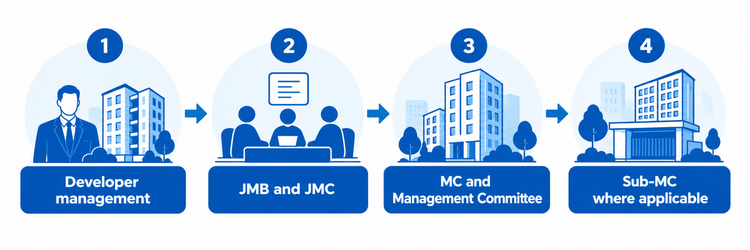
The developer initially manages the development. The JMB subsequently takes over during the interim stage, with its joint management committee conducting the JMB’s business.
Once the strata register is opened, the MC comes into existence and ultimately assumes management responsibilities. Where limited common property is designated, a Sub-MC may later be established to manage that specific property.
Who Should Strata Owners Approach About Management Issues?

The appropriate body depends on the development’s management stage and the nature of the issue. Strata owners can generally consider the following:
- JMB or MC: Approach the current management body for common property maintenance, cleaning, security, facilities, repairs, maintenance charges, and other day-to-day management matters.
- JMC or Management Committee: Raise matters that require attention from the committee conducting the business of the JMB or MC.
- Sub-MC: Approach the Sub-MC when an issue relates specifically to designated limited common property under its management.
- Commissioner of Buildings (COB): Consider approaching the relevant Commissioner of Buildings (COB) for matters involving compliance with strata management requirements or the performance of statutory duties.
- Strata Management Tribunal: Certain strata management disputes and claims within the Tribunal’s jurisdiction may be brought before the Strata Management Tribunal.
Identifying the nature of the problem and the body currently responsible for the development can help owners direct their questions, complaints, or claims to the appropriate party.
ButtonCan A JMB Or MC Increase Maintenance Fees And Sinking Fund Contributions?
Yes. Maintenance charges and sinking fund contributions may change depending on the costs of managing and maintaining the strata development.
- Maintenance charges: The JMB or MC can determine and impose charges for the maintenance and management of common property.
- Sinking fund: Separate contributions are collected for specified capital expenditure and other purposes permitted under the Strata Management Act 2013.
- Changes in charges: Amounts may be revised when collections are insufficient to cover the development’s management and maintenance expenses.
- Disputes: Owners should not simply stop paying because they disagree with the amount. They can raise concerns with the management body or pursue an appropriate dispute resolution channel.
Owners should check the relevant notices, budgets, accounts, and meeting documents to understand how the charges have been determined.
What Happens If A JMB Or MC Fails To Perform Its Duties?
A JMB or MC has statutory responsibilities relating to matters such as common property, finances, insurance, records, and by-laws. When these responsibilities are not properly carried out, parcel owners have several possible ways to raise their concerns.
Depending on the issue, owners may:
- Contact the management: Raise maintenance, financial, or administrative concerns with the JMB, MC, or management office first.
- Raise the matter at a general meeting: Eligible matters can be discussed with other owners through an AGM or Extraordinary General Meeting (EGM).
- Approach the COB: The relevant Commissioner of Buildings may deal with certain issues involving compliance with the Strata Management Act 2013.
- Consider the Strata Management Tribunal: Certain disputes and claims falling within its jurisdiction can be brought before the Tribunal.
- Seek legal advice: More complex disputes may require professional legal advice to determine the appropriate course of action.
The appropriate route depends on the nature of the problem and the powers available to the relevant authority or tribunal.
Can You Take Legal Action Against A JMB, MC, Or Sub-MC?
Yes, legal action may be possible against a JMB, MC, or Sub-MC, depending on the nature of the dispute. These entities have body corporate status and can sue or be sued in their own names.
Before taking action, owners should consider:
- Nature of the dispute: Determine whether the issue concerns maintenance, charges, by-laws, common property, or another management responsibility.
- Strata Management Tribunal: Certain disputes and claims under strata management laws may fall within the Tribunal’s jurisdiction.
- Court action: Some matters may require court proceedings, particularly where they fall outside the Tribunal’s jurisdiction.
- Legal advice: Owners may wish to seek professional advice to determine the appropriate party and legal route.
The joint management committee (JMC) is different because it conducts the JMB’s business rather than operating as a separate body corporate. Owners should therefore identify the correct management body before starting legal proceedings.
Can A JMB, JMC, Or MC Make And Enforce House Rules?
Yes. The Strata Management Act 2013 and its regulations provide by-laws for strata developments. The JMB and MC may also make additional by-laws in accordance with the Act.
These may cover:
- Safety and security
- Common property use
- Parking
- Renovations
- Resident behaviour
- Pets
- Refuse disposal
The joint management committee conducts the JMB’s business but cannot independently introduce any rule it chooses. Additional by-laws must follow the applicable legal requirements. Owners disputing a rule should check the relevant by-laws
Understanding Your Strata Management Structure
Effective strata management depends on knowing which body or committee is responsible at each stage of a development.
While the responsibilities of the JMC, JMB, MC, and Sub-MC may overlap, each has a different legal role within Malaysia’s strata management framework. Knowing which body or committee is currently responsible can make it easier to raise maintenance concerns, understand charges, resolve disputes, and participate in decisions affecting the development.
Planning your home loan repayments? Estimate your monthly payments with the Mortgage Calculator on iProperty Malaysia.