Understand how Short-Term Residential Accommodation (STRA) is evolving in Malaysia, including proposed national guidelines, Selangor’s 180-night cap, strata by-law restrictions, and tax obligations. Learn the legal risks, compliance steps, and what Airbnb hosts should prepare for in 2026.

Short term rental (STR), such as listing your home on Airbnb Malaysia or similar platforms, has become a popular source of revenue for property owners in Malaysia. But as STR grows, so does regulatory scrutiny.
In 2026, STR in Malaysia is in a transitional period; the legal framework is being formalised, but many proposed changes remain in draft form.
If you’re a host, investor, or property owner, it’s essential to understand what is currently allowed, what is planned, and where the most significant legal risks lie.
What Is STRA (Short-Term Residential Accommodation)?
As the STRA market expands rapidly, governments and housing authorities have recognised the need for structured oversight.
Regulation ensures that the sector continues to grow responsibly, balancing the interests of hosts, guests, and the wider community.
Key objectives include:
1. Supporting Homeowners
- Allowing property owners to earn additional income, particularly from unused or under-utilised space.
- Encouraging tourism and local economic activity through flexible accommodation options.
2. Protecting Residents and Neighbourhoods
- Minimising noise complaints and disturbances associated with high guest turnover.
- Reducing risks of overcrowding, unauthorised gatherings, and misuse of facilities.
- Managing traffic and parking issues in high-density residential zones.
- Ensuring compliance with safety standards and emergency-readiness (e.g., fire safety measures).
3. Maintaining Housing Stability
- Safeguarding the availability and affordability of housing for long-term residents, preventing speculative conversion of homes solely into tourist accommodation.
In essence, STRA offers valuable flexibility in the modern property and travel landscape. Still, it requires clear rules to ensure that hosts’ profitability does not come at the expense of community well-being.
How Malaysia Is Shaping Its Future STRA Regulations?
Malaysia is in the midst of shaping a unified approach to regulating short-term residential accommodation.
While short-stay rentals continue to grow in popularity, the rulebook for operators remains a work in progress, with national direction on the horizon.
Draft Framework Under Development
The Ministry of Housing and Local Government (KPKT), through PLANMalaysia, has prepared a set of national STRA guidelines intended to bring consistency across states and local councils.
These guidelines are designed to:
- Provide a clear compliance pathway for hosts
- Safeguard residential communities
- Support tourism growth without compromising liveability.
According to the Deputy Tourism, Arts and Culture Minister, the draft guidelines are expected to move through the following stages:
- Cabinet consideration, where policy alignment is reviewed at the Federal level
- Submission to the National Council for Local Government, which coordinates implementation across states
As of mid-2025, these guidelines are not yet finalised or enforceable, meaning operators remain subject to varying local rules rather than a single national standard.
Licensing Requirement (Conditional)
One of the key proposals within the upcoming framework is the introduction of mandatory business licensing for STRA premises.
Under this model:
- Hosts would need to secure a licence from their local authority before
- Registering their property officially as a tourist accommodation
This requirement reflects a shared stance between:
- KPKT, focused on safeguarding housing governance, and
- MOTAC (Ministry of Tourism, Arts and Culture) is responsible for tourism sector oversight
However, and this is crucial, this remains a forward-looking regulation. While local councils are free to introduce their own rules in the meantime, there is currently no nationwide licensing obligation imposed on all STRA operators.
Selangor’s STRA Plan: What Has Been Announced
Selangor is at the forefront of state-level STRA regulation, but its plans are still not fully formalised.
180-Night Cap (Planned)
- The Selangor state government has publicly floated a maximum annual stay of 180 nights for STRA units.
- According to state officials, STR operators who wish to exceed the 180-night limit may need to apply for special planning permission.
- However, these are draft proposals: the state has said that final implementation depends on Cabinet-level STRA guidelines and state legislation.
Registration & Sustainability Fee (Planned)
- As part of Selangor’s STRA strategy, a mandatory registration scheme is expected, potentially involving MOTAC or the local authority.
- The state also plans to introduce a sustainability fee on STR bookings, though its final form and rate have not yet been confirmed.
For now, STRA operators in Selangor should stay informed and be prepared to adapt quickly, as the upcoming regulatory framework will shape how short-stay rentals operate in the state.
STR in Strata Properties: Key Legal Precedent
One of the most important legal considerations for STR in Malaysia is its interaction with strata (condo) ownership.
Federal Court Ruling, Verve Suites Mont’Kiara
- In the case of Innab Salil & Ors v Verve Suites Mont’ Kiara Management Corporation, the Federal Court held that a Management Corporation (MC) or Joint Management Body (JMB) may enact house rules to prohibit short-term rentals.
- The Court clarified that such rules do not automatically violate Section 70(5) of the Strata Management Act (SMA) 2013, even though that section restricts by-laws that inhibit certain “dealings” with parcel units.
- The STR stays were treated not as “leases” but as “licences” under the law, giving MCs legal grounds to restrict them.
What does this mean for Owners?
- Even if STRs become fully regulated at the national or state level, your JMB/MC may still block them under valid house rules.
- A building’s bylaws, passed with a sufficient vote (for example, 96-4 at Verve Suites), can enforce a total prohibition on short-term Airbnb-style rentals.
- This remains one of the most powerful checks on STR in high-rise, stratified developments.
Ultimately, this precedent underscores that, regardless of broader regulatory developments, the decisive authority over STRs in strata properties will continue to rest with each building’s by-laws and the collective will of its residents.
Calculate repayments to narrow down your choices.What Zoning and Planning Rules Mean for Your Short-Term Rental?

Short-term rental (STR) activity can raise zoning and planning issues, especially in developments approved strictly for residential use.
In some cases, running an STR may be treated as a material change of use, which could require planning permission, depending entirely on local authority zoning rules.
Key points to note:
- Zoning rules differ by area: Some councils restrict residential zones to long-term living, while others allow mixed-use or limited commercial activity.
- Strata by-laws still apply: Even if zoning allows STR, your MC or JMB can prohibit it through building by-laws, which take precedence within the development.
- Enforcement is inconsistent: Local councils vary widely in how strictly they monitor and enforce STR activities, making compliance risk highly location-dependent.
In short, owners must consider both local zoning requirements and their building’s by-laws before operating STRs, as approval from one does not guarantee approval from the other.
Tax Implications for STR Hosts
Running a short-term rental (STR) comes with tax responsibilities, and hosts should understand how their income may be assessed.
Income Tax Considerations
- Taxable income: All earnings from STR activities are taxable. Depending on scale and services offered, they may even be classified as business income rather than simple rental income.
- Registration with LHDN: Hosts must register with the Inland Revenue Board (LHDN) and declare their STR income accurately to avoid penalties or backdated assessments.
Indirect Tax Obligations
- Possible service tax exposure: If the STR is considered a tourism or lodging business, indirect taxes, such as service tax, may apply, subject to national thresholds and the operation’s structure.
- Evolving regulatory framework: With the STRA licensing system still being developed, the exact tax treatment may change. Hosts should seek updated guidance from LHDN or a qualified tax adviser.
In summary, STR operators must stay proactive with tax compliance, as both income and indirect tax rules may evolve once the national framework is finalised.
Key Risks for Hosts in 2026
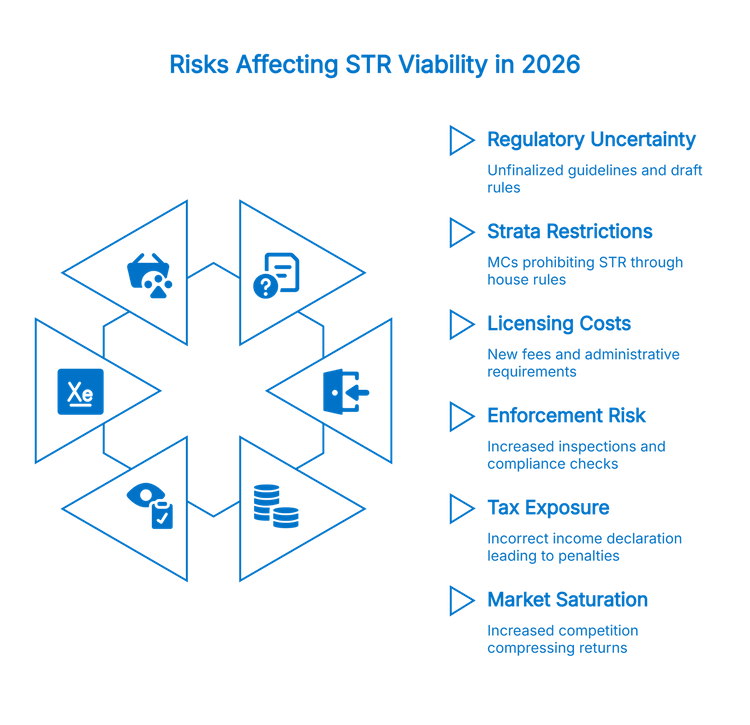
Before deciding whether to pursue STR in 2026, hosts should be aware of the key risks that could directly affect profitability, compliance, and long-term viability.
1. Regulatory Uncertainty
- The national STRA guideline has yet to be finalised, leaving many operational details unclear.
- State-level rules, such as Selangor’s proposed 180-day cap, remain in draft form and may change before implementation.
2. Strata Restrictions
- Management Corporations (MCs) can already prohibit STRs under house rules, as established by the Verve Suites Federal Court ruling.
- Even if national or local licensing is introduced, STRs can still be blocked if the JMB/MC passes a valid by-law prohibiting them.
3. Licensing & Operating Costs
- Should local authorities require licences, hosts may face new fees and administrative requirements.
- Compliance may also require safety upgrades (e.g., fire, security, and waste management systems).
4. Enforcement Risk
- Once the STRA framework is formalised, local councils may increase inspections and compliance checks.
- Operators who fail to meet requirements risk fines, penalties, or forced suspension of operations.
5. Tax Exposure
- An incorrect or incomplete income declaration can trigger tax liabilities, audits, or penalties.
- Structuring the STR incorrectly (e.g., as a personal rental rather than a business) may also create additional tax issues.
6. Market Saturation
- As STR becomes more regulated, more units may enter the market legally, increasing competition.
- In high-supply urban areas, stronger competition may compress returns and reduce overall yield.
Taken together, these risks show that successful STR hosting in 2026 will depend not just on demand but on careful compliance, financial planning, and a clear understanding of the evolving regulatory landscape.
Airbnb Malaysia
Airbnb Malaysia remains a popular platform for both domestic and international travellers, offering flexible stays in cities such as Kuala Lumpur, Penang, Johor Bahru, and Kota Kinabalu.
The market continues to expand, but it operates within a mixed regulatory environment shaped by local councils and strata by-laws.
Key points to understand:
- Regulation varies by location: Malaysia has no single nationwide law for short-term rentals. Each local authority sets its own rules so that compliance requirements can vary significantly across areas.
- Strata by-laws still govern buildings: Even if a council permits STR activity, a Management Corporation (MC) or Joint Management Body (JMB) may restrict or prohibit Airbnb within its development.
- Tourism Tax applies: Foreign guests staying at registered STR units are subject to a flat per-night Tourism Tax, unless exempted under specific government directives.
- Market demand remains strong: Urban centres with strong connectivity, business districts, and lifestyle amenities continue to attract steady short-term rental traffic year-round.
Overall, Airbnb Malaysia offers strong earning potential, but hosts must ensure full compliance with local regulations and building by-laws before operating.
What Hosts Should Do Right Now?
Here’s a practical roadmap for STR hosts and property owners to prepare for the evolving regulatory environment:
| Action | Why It Matters |
| Review your building’s bylaws | Check if your JMB/MC already prohibits STR. Even if you get a licence, you may not be allowed. |
| Track STRA guideline updates | Stay informed on national and state-level rule developments. |
| Engage with your MC/JMB | Propose or negotiate house rules for STR; gauge owner sentiment. |
| Prepare for licensing | Set aside a budget for applying for local authority licences, if required. |
| Improve safety and maintenance. | Implement fire safety, guest registration, security, and waste management in line with draft standards. |
| Document all operations | Maintain records of bookings, revenue, and guest identities; this will help with tax and compliance. |
| Revisit your financial model. | Factor in possible fees, licence costs, and reduced nights if caps are enforced. |
By taking these steps now, hosts can stay compliant, reduce future disruptions, and position themselves firmly no matter how Malaysia’s STR rules evolve.
Why the 2026 Moment Is Critical?
2026 is shaping up to be a defining year for STR regulation in Malaysia, with several significant developments happening at once:
- National STRA Guidelines: The Cabinet is expected to review PLANMalaysia’s proposed framework, which could finally set nationwide rules.
- State-Level Models: Selangor’s proposed 180-night cap may become one of the first full state regulatory models and could influence other states.
- Licensing Direction: With MOTAC and KPKT aligning on STR licensing, operators should expect more formalised requirements similar to other tourism businesses.
For hosts, this convergence of policy decisions means it’s wise to prepare early. Strengthening compliance and understanding upcoming rules now can make navigating future regulations far easier.
Preparing for the Next Phase of STR Regulation
Short-term rentals in Malaysia are far from being outlawed, but they no longer operate in a regulatory vacuum. What was once a largely informal arrangement is evolving into a more regulated, formal accommodation sector.
- National STRA guidelines are being drafted, but are not yet law.
- Selangor has proposed an annual 180-night cap, but final legal instruments are still under development.
- Strata management bodies (MCs and JMBs) already have, and can enforce, strong controls over STR through house rules, a power confirmed by the Federal Court.
- Tax and licensing obligations are likely to increase, so STR must be treated more like a small lodging business than a side hustle.
If you run STR or plan to become a host, now is the time to get your house in order. Compliance, preparation, and engagement with your management body will determine whether you succeed in the next phase of STR regulation.
Explore our latest property guides on iProperty Malaysia to understand market trends, ownership rules, and buying strategies.