

© SIphotography | Getty Images
A neighbour who plays loud music late at night, holds loud gatherings every weekend or keeps drilling through the wall can make it impossible to sleep, work or relax at home. When you have already asked them to turn it down, and the noise still returns, the problem can quickly become a recurring source of stress.
Instead of tolerating the disturbance or confronting your neighbour in anger, start by identifying what is causing the noise and how often it happens. Your next step may involve speaking to the neighbour, approaching your JMB or MC, contacting the relevant local authority or making a report, depending on your property and the circumstances.
In this guide, you will learn when repeated noise may amount to a nuisance in Malaysia, where to make a noise complaint, what evidence can strengthen your complaint and what you can do when the disturbance continues.
Find a suitable place to live from a wide range of homes for rent.When Does Neighbour Noise Become a Nuisance?
A noisy neighbour is not automatically a legal nuisance. The key question is whether the noise causes an unreasonable interference with your use or enjoyment of your home.
A one-off disturbance may be inconvenient, but repeated noise that disrupts your sleep or daily life can be more serious. Courts may consider factors such as the time, place, extent, manner and continuity of the disturbance.
Common examples that may raise a nuisance concern include:
- Repeated loud music or parties
- Persistent drilling, hammering or home renovation noise
- Recurring banging or vibration from machinery or equipment
- Other noise that repeatedly interferes with the normal use of your home
There is no single noise level that automatically determines whether a nuisance exists. In Ong Koh Hou v Perbadanan Bandar & Anor [2009], the High Court considered persistent banging from a defective water pump and found that the circumstances were sufficient to constitute a nuisance. The case shows why the frequency and persistence of the disturbance, rather than simply the existence of noise, can be important.
What Should You Do Before Making a Noise Complaint?
Before making a formal complaint, give your neighbour a chance to address the problem, provided it is safe to speak to them.
- Speak to your neighbour calmly
Tell them what the noise is, when it happens and how it affects you. Be specific rather than making personal accusations. For example, explain that loud music has been keeping you awake several nights a week instead of simply saying that they are “too noisy”.
- Try to agree on a practical solution
Ask whether your neighbour can lower the volume, change the timing or reduce the noise in another way. If the disturbance continues, record the incidents and any steps already agreed.
- Keep a record if the problem continues
Once the disturbance becomes recurring, record each incident so you can show a pattern rather than relying on memory.
Note the:
- Date and time
- Duration
- Type of noise
- Frequency
- Likely source
- Impact on your household
Keep relevant messages, emails and complaint records to support a formal complaint to your building management, local authority or another appropriate body.
Explore homes for sale in Malaysia and find a better fit for your needs.What Can You Do If the Noise Continues?
If the noise continues after you have complained, do not restart the same argument with your neighbour. Use your existing complaint record to move the matter to the next appropriate channel.
- Follow up with the management body or authority
Refer to your earlier complaint and add details of any new incidents. Keep copies of your correspondence, complaint numbers and responses so you can show that the disturbance is ongoing.
- Escalate a strata dispute where appropriate
If your JMB or MC has not resolved the noise complaint, you may be able to file a claim with the Strata Management Tribunal (SMT), known in Bahasa Malaysia as Tribunal Pengurusan Strata (TPS), under the Strata Management Act 2013.
The Tribunal hears specific disputes under the Act and its subsidiary legislation, including claims to enforce or prevent breaches of strata by-laws. The current claim limit is RM250,000, and claims can be filed online through the e-TPS system.
Where Can You Report a Noisy Neighbour in Malaysia?

The right place to complain depends mainly on where you live and what is causing the noise.
- If you live in a condominium or other strata property
If you live in a condominium, apartment, or other strata development, start with the body that manages your property. Depending on the development, this may be the management office, Joint Management Body (JMB) or Management Corporation (MC).
Before making a complaint, check:
- House rules: Your development may have additional rules on noise and resident conduct.
- Strata by-laws: The Strata Management Act 2013 and its subsidiary regulations provide the legal framework for strata management in Peninsular Malaysia and the Federal Territory of Labuan, including rules governing the use and enjoyment of parcels and common property.
- Complaint procedure: Check how your management body accepts complaints and what supporting information it requires.
Checking these rules first can help you determine whether the noise breaches an applicable by-law and gives the management body a clear basis for addressing your complaint.
- What noise rules apply to strata properties?
Under the Strata Management (Maintenance and Management) Regulations 2015, certain sounds from electrical equipment, appliances and musical instruments must be kept at a low volume after 11 pm.
If they disturb other residents’ rest or sleep, prior written approval has been granted for a specific function and duration. Check your development’s additional by-laws, as the rule is not a blanket ban on all noise.
- If you live in a landed property
For a landed home, there is usually no JMB or MC to handle disputes between neighbouring properties. Depending on the nature of the nuisance, your local authority may be the appropriate place to make a complaint.
Keep in mind:
- Local authorities handle different areas: Depending on where you live, this may be a city, municipal or district council.
- Complaint procedures can differ: Check your local authority’s official website for its noise or nuisance complaint process.
- Give specific details: Include the location, time, type of noise, and any supporting evidence requested by the authority.
- Check the applicable rules: The requirements for noise and nuisance can vary depending on the activity, property, and local regulations.
For a landed property, identifying the local authority responsible for your area is the first step towards using the correct complaint channel.
Your complaint route depends on your property type and the noise source. Check applicable rules first, then contact the appropriate management body or local authority.
When Should You Contact The Police?
A neighbour-noise dispute does not always require police involvement. Consider making a police report if the situation also involves threats, intimidation, violence, property damage or another potential offence.
Section 13 of the Minor Offences Act 1955 also covers certain excessive-noise situations. For example, it applies to specified instruments or utensils used within town or village limits between midnight and 6 am when they cause annoyance or inconvenience, as well as certain mechanically or electrically produced music.
The law applies to specific types of noise and circumstances, so it would be inaccurate to say that all residential noise is illegal after midnight.
When is the Department of Environment relevant?
The Department of Environment (DOE) handles complaints about environmental pollution that fall under the Environmental Quality Act 1974 and its regulations. This includes certain forms of noise pollution covered by the Act.
DOE may be relevant when noise comes from an industrial, construction or other activity subject to environmental controls, rather than an ordinary dispute between residential neighbours. Its environmental-noise guidelines provide recommendations for assessing and controlling noise from projects and other activities where environmental noise is a concern.
For a typical residential neighbour dispute, check the relevant JMB/MC, local authority or other appropriate complaint channel first.
Estimate your monthly home loan repayments with the Mortgage Calculator.How Should You Make a Formal Noise Complaint?
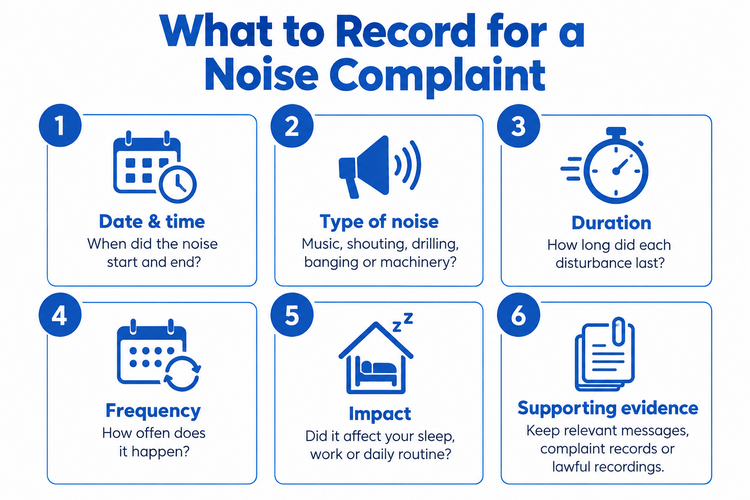
Once you know where to complain, give the management body or authority enough information to understand what is happening, when it happens, and how often it occurs.
Step 1: Write a clear, factual complaint
Describe the noise, when it occurs, and how it affects your household. Explain whether you have spoken to the neighbour or tried other ways to resolve the issue. Avoid assumptions about their intentions or emotional accusations.
Step 2: Attach relevant evidence and request action
Use your noise log, relevant messages and previous complaint records to support your account. The infographic below outlines the key details to record. End your complaint by stating what you want the recipient to do, such as investigate the disturbance, check whether building rules have been breached or advise you on the next steps.
Step 3: Submit your complaint and keep a record
Once your complaint and supporting evidence are ready, submit them to the appropriate body based on your property type and the nature of the disturbance.
- Condominium or strata property: Submit your complaint to the building management office, JMB or MC.
- Landed property: Contact the local authority responsible for your area and follow its official complaint procedure.
- Threats, violence or suspected offences: Contact the police where appropriate, particularly if your safety is at risk.
- Environmental noise pollution: Submit a complaint to the DOE if the issue falls within its jurisdiction.
Use the recipient’s official complaint form, email address or online portal. Keep a copy of your submission and note any reference number so you can follow up if the disturbance continues.
Can You Take Legal Action Against a Noisy Neighbour?
If your neighbour’s noise repeatedly interferes with your use or enjoyment of your home, you may have grounds for legal action. The appropriate route depends on the nature of your dispute and whether it falls within the jurisdiction of a tribunal or court.
If you live in a strata property, you may be able to bring an eligible dispute before the SMT, known in Bahasa Malaysia as TPS. The Tribunal handles specific disputes under the Strata Management Act 2013, including certain claims involving breaches of strata by-laws. Its claim limit is RM250,000.
For disputes that fall outside the Tribunal’s jurisdiction, or where a civil nuisance claim is otherwise appropriate, you may consider taking the matter to court. Depending on the circumstances and evidence, the court may grant an injunction to stop the nuisance or award damages for losses suffered.
Before proceeding, keep your complaint records and supporting evidence together. A lawyer can assess whether your circumstances justify legal action and which route is appropriate for your case.
Dealing With Noisy Neighbours in Malaysia
A recurring noise problem can make it difficult to sleep, work or enjoy your home, but you do not have to jump straight into a legal dispute. Start by speaking to your neighbour where it is safe to do so, then keep a clear record if the disturbance continues.
Start with the least confrontational step that is appropriate for your situation, keep a clear record of recurring disturbances and use the complaint channel that applies to your property. If those steps do not resolve a serious nuisance, your records can help you decide whether further escalation or legal advice is appropriate.
Looking for guidance throughout your property journey? Explore Property Guides for practical information to help you make informed property decisions.