
If a fire damages your home, the cost goes well beyond repairing walls and the roof. Furniture, appliances, built-in renovations and other belongings can also be affected. For condo owners, there is an added concern: if the building already has a master insurance policy, do you still need separate fire insurance?
The gap in protection can be costly. According to data cited by PIAM from the Department of Statistics Malaysia, Malaysia had 9.10 million households in 2024, while 3.88 million fire and home insurance policies were recorded, representing a take-up rate of 42.6 per cent. A basic fire policy can protect a building against specified fire-related risks, but broader houseowner and householder policies can cover additional risks, the building and/or its contents, depending on the policy.
This guide explains what fire insurance for a house covers, how it differs from houseowner and householder insurance, and how to assess the cover you need before buying or renewing a policy.
Explore homes for sale across Malaysia and find a property that suits your needs.What Is Fire Insurance for a House?
Fire insurance is property insurance designed to protect your home against financial loss when an insured fire-related event damages or destroys the property. In Malaysia, a basic fire policy is primarily concerned with protecting the insured building, rather than providing comprehensive protection for everything in and around the home.
The level of protection depends on the policy you choose, the property insured and any additional cover you add. This means having fire insurance does not necessarily mean your building, belongings and other risks are all covered under the same policy.
Understanding what the policy actually protects is therefore important before you decide how much cover you need.
What Does Fire Insurance for a House Cover?
A basic fire policy in Malaysia is designed to protect the insured building against specified fire-related perils, including:
- Fire
- Lightning
- Explosion
If a covered fire damages your home’s structure, the policy may pay for the insured loss, subject to its sum insured, terms, conditions and exclusions. The basic fire policy provides coverage for the building against fire, lightning and explosion.
However, fire insurance does not cover every type of damage to your home. Flood, earthquake and windstorm may require additional cover, which can usually be added to a policy for an extra premium.
Flood protection, in particular, should not be assumed. PIAM reported that only around 30% of fire material-damage policies had flood cover in 2021, based on data from Insurance Services Malaysia. Although this is not a current penetration figure, it highlights why homeowners should check whether flood cover is included or needs to be added.
Does Fire Insurance Cover Furniture And Belongings?
A basic Fire Policy primarily protects the insured building, so furniture, appliances, electronics, clothing and other personal belongings are generally not covered. Separate householder or contents cover may be needed to protect these items.
When buying or renewing a policy, check whether your belongings are insured and review any applicable limits, exclusions and conditions. The policy wording sets out what you can claim for.
Explore rental properties across Malaysia and find your ideal home.What Is Not Covered by Fire Insurance?
A basic fire policy has limited coverage and does not protect against every type of property damage or loss. Common gaps include:
- Household contents: Furniture, appliances, electronics and personal belongings are generally not covered by a basic fire policy, which primarily protects the insured building.
- Natural disasters: Flood, earthquake and windstorm damage may be excluded unless additional cover is purchased.
- Theft: Some standard fire policy wordings exclude losses caused by theft during or after a fire.
Exclusions vary by policy. Review the policy wording to understand what is not covered and whether additional protection is available.
Fire Insurance vs Houseowner vs Householder Insurance
These policies differ in what they protect and the level of protection they are designed to provide. A basic fire policy focuses on specified fire-related damage to the building, while houseowner and householder policies can provide broader protection for the home and its contents.
| Feature | Fire Insurance | Houseowner Insurance | Householder Insurance |
| Protects | The insured building | The building and permanent fixtures | Household contents and personal belongings |
| Typical risks covered | Fire, lightning and explosion | Fire and other insured perils, depending on the policy | Loss or damage to contents from insured perils, depending on the policy |
| Furniture & appliances | Usually not covered under a basic fire policy | May be covered if included | Designed to cover household contents |
| Flood protection | Usually requires an extension | May be available depending on the policy | May be available depending on the policy |
| Theft protection | Not the main purpose | May be included depending on the policy | May cover eligible household belongings, subject to the policy |
| Best suited to | Protecting the building against specified fire-related risks | Homeowners who want broader protection for the property | Homeowners or tenants who want protection for belongings |
| Key limitation | Narrower protection and mainly building-focused | Coverage varies by policy | Does not primarily insure the building itself |
The right option depends on whether you need to protect the building, the contents inside it, or both. A homeowner may need more than a basic fire policy if they also want protection against other risks or for their belongings.
Do You Need Fire Insurance for Your House?
Whether you need a separate fire policy depends on what you own, what is already insured and whether your lender or strata management body has already arranged building cover. The right approach therefore differs depending on whether you own a landed property, own a condo, rent your home or let out a property.
- If You Own a Landed House
For a landed property, you are responsible for making sure the building has adequate insurance protection.
- Basic building protection: A basic fire policy can cover the building against specified risks such as fire, lightning and explosion.
- Broader protection: If you also want to protect household contents or cover risks beyond those included in a basic fire policy, consider whether broader home insurance is appropriate for your needs.
- Additional risks: Do not assume every risk is included. For example, flood protection may require an extension to a basic fire policy.
- If You Own a Condo or Apartment
For a strata property, check the master policy before buying separate building insurance.
- Building insurance: The JMB, MC or relevant Subsidiary MC is required to purchase building damage insurance for the whole building under the Strata Management Act 2013. Parcel owners contribute towards the premium.
- Duplicate building cover: Once the JMB, MC or Subsidiary MC has taken a fire policy, an individual parcel owner does not need another fire policy to insure the same unit against the same building risk.
- Your contents: Check the master policy to understand whether your furniture, electronics, personal belongings, and other items within the unit are covered.
- Financing requirements: If you have a home loan, check your financial institution’s insurance requirements before arranging additional cover.
- If You Are a Tenant
As a tenant, the building itself is generally not your insurance responsibility because you do not own it. Your main consideration is protecting the belongings you own inside the property.
- Building: You generally do not need to insure the building itself.
- Personal belongings: Householder insurance may be relevant if you want protection for personal possessions and liability within the home. PIAM identifies householder insurance as suitable for tenants.
- If You Are a Landlord
As a landlord, your priority is protecting the property you own and any belongings you provide with it.
- Building protection: Houseowner insurance can provide protection for the building, personal belongings and liability, depending on the policy.
- Contents: If the property is furnished, check whether furniture, appliances and other items belonging to you are covered.
- Loss of rent: A Houseowner policy may provide loss of rent cover when the private dwelling is damaged by an insured peril and becomes uninhabitable, subject to the policy’s limits and terms.
The key is to identify what is already insured first, then arrange additional cover only for genuine gaps. This can help you avoid duplicate protection while ensuring the property and belongings you are responsible for are adequately covered.
How Much Fire Insurance Does Your House Need?

Your sum insured should reflect the cost of rebuilding the insured building, not its market value. Insuring the property at the wrong amount could leave you underinsured after a major loss.
1. Base the Sum Insured on Rebuilding Cost
Market value includes factors such as land and location, while rebuilding cost reflects what it would cost to reconstruct the insured building. Using the market value as the sum insured could leave you with insufficient cover to rebuild after a major loss.
2. Calculate the Rebuilding Cost
Building Cost Calculator considers factors including:
- Property type, age and quality
- Gross built-up area
- Built-in furniture and home renovations
- Improved finishes and other features
- Construction, demolition and removal costs
- Professional consultancy costs
The calculator provides an estimate, while unusual or complex properties may require professional valuation.
3. Review Your Sum Insured After Major Changes
Review your sum insured after major renovations, permanent improvements or significant electrical upgrades that could increase rebuilding costs. If you install a permanent EV charger, notify your insurer because associated electrical upgrades may affect the rebuilding cost and appropriate sum insured.
How Much Does Fire Insurance for a House Cost?
There is no fixed premium for every Malaysian home. The cost depends on the property being insured, the sum insured, the construction characteristics and the level of protection selected.
Malaysia’s fire insurance premiums reached RM5 billion in 2025, up 6.9% from RM4.7 billion in 2024. The increase was driven partly by sum-insured inflation on residential sub-sales, largely reflecting rising rebuilding costs.
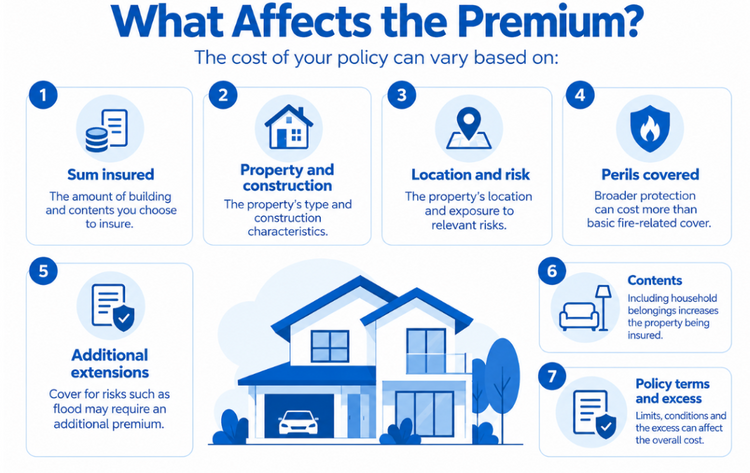
The final premium will depend on the level of cover you choose, so compare the premium alongside the sum insured, covered risks, extensions, exclusions and excess rather than choosing the cheapest policy alone.
Calculate your monthly mortgage repayments with this easy-to-use calculator.How to Choose the Right Fire Insurance for Your House
The cheapest policy is not necessarily the right one. Before buying or renewing, check what it covers, where gaps may exist, and whether the sum insured reflects your property’s needs.
1. Check What the Policy Insures
Confirm whether the policy covers the building, household contents, or both, as a basic fire policy primarily protects the insured building.
2. Check the Covered Perils and Extensions
Check which risks are included and whether flood, windstorm, earthquake or other relevant risks require additional cover.
3. Read the Exclusions and Limits
Review the exclusions, sub-limits, conditions and restrictions that could affect whether you can claim for a particular loss.
4. Set the Sum Insured Using Rebuilding Cost
Base the building sum insured on a reasonable rebuilding-cost estimate, rather than simply the property’s market value.
5. Account for Renovations and Permanent Improvements
Check that renovations, upgraded finishes and permanent fixtures are reflected in the insured value where applicable.
6. Review Contents Protection
If you want to protect electronics, furniture, appliances or valuables, check their contents limits, exclusions and policy conditions.
7. Check the Excess
Check the excess payable on a claim and whether different excesses apply to different types of loss.
8. Check Existing Strata Cover
If you own a condo or apartment, review the master building policy first to avoid duplicate cover for the same building risk.
The right policy is one that provides appropriate protection for the property, belongings and risks you are responsible for, without unnecessary gaps or duplicate cover.
How to Make a Fire Insurance Claim
If your home is damaged by fire or another insured event, make sure everyone is safe first. Once the immediate danger has passed, document the damage and notify your insurer as soon as possible. Timely reporting and accurate documentation to help with claims processing.
1. Prevent Further Damage Where Safe
Take reasonable steps to prevent further damage, but obtain written approval from your insurer before proceeding with any house repair, including emergency work, as unauthorised work may not be covered by your homeowner policy/certificate.
2. Document the Damage
Take clear photographs and videos of the damage before cleaning up, and make a list of damaged belongings with details such as brand, model and serial numbers where available.
3. Notify Your Insurer
Contact your insurer, agent or broker as soon as possible to report the incident and start the claims process. Check your policy for any specific notification timeframe, as requirements can vary.
4. Prepare Supporting Documents
Depending on the claim, you may need a completed claim form, photographs, proof of ownership, repair quotations, police or Fire and Rescue Department reports, and an inventory of damaged contents. Your insurer may request additional documents based on the circumstances.
5. Cooperate With the Assessment
For larger losses, the insurer may appoint a loss adjuster to inspect the damage and assess the claim. Provide the requested information and cooperate with the assessment before proceeding with major repair or rebuilding work.
Keep copies of your claim form, photographs, reports, receipts and correspondence throughout the claims process so you have a complete record of your claim.
Protecting Your Home With the Right Insurance
Fire insurance can protect you from significant financial losses, but basic fire cover does not protect every part of your home or every type of risk. The right level of protection depends on your property, the risks it faces and whether you also need cover for your household belongings.
Before choosing a policy, check the covered perils, exclusions, sum insured, contents protection and excess. If you own a strata property, also check the existing master policy to avoid duplicate cover. For the building, base the sum insured on a realistic rebuilding cost and review your cover after major renovations or improvements.
Looking for guidance on protecting your home? Get practical insights on property ownership and more with Property Guides on iProperty Malaysia.