

You may have found a piece of land in Malaysia that suits your budget and location preferences, only to discover that you are not eligible to purchase it. This can happen when a property is classified as Malay Reserve Land, which is subject to specific ownership and transfer restrictions.
Unlike ordinary land, Malay reserve land is governed by state-specific laws that generally restrict ownership to Malays who meet the applicable legal definition. It is also different from a Bumiputera Lot, although the two are often confused. These distinctions can affect property purchases, financing, inheritance, and future resale.
This guide explains what Malay reserve land means in Malaysia, the laws governing it, who can own it, and what buyers should check before entering into a property transaction.
Browse properties for rent in Malaysia and find a home that suits your needs.What Is Malay Reserve Land In Malaysia?
Malay Reserve Land, also known as Tanah Rizab Melayu, refers to land reserved for Malay ownership under the applicable Malay Reservation Enactment. Its purpose is to protect land ownership and prevent reserved land from being transferred to individuals who do not meet the legal definition of Malay under the relevant state law.
Unlike ordinary property titles, these lands are subject to specific restrictions on who can own, purchase, sell, transfer, or inherit them. The requirements can vary between states because land administration falls under state jurisdiction.
According to the Ministry of Natural Resources and Environmental Sustainability, Peninsular Malaysia had approximately 4.95 million hectares of Malay reserve land in 2024, compared with 4.82 million hectares in 2020. Kelantan, Perak, and Kedah recorded the largest areas. These figures were reported in January 2026.
What Laws Govern Malay Reserve Land In Malaysia?
The legal framework primarily involves Article 89 of the Federal Constitution and the Malay Reservation Enactments applicable in individual states.
These laws govern matters such as:
- Ownership eligibility: Who legally qualifies to own reserved land.
- Property transfers: Restrictions on selling, transferring, or otherwise dealing with the land.
- Home Financing: Conditions affecting mortgages and charges over the property.
- Reservation status: Procedures and constitutional requirements for declaring or revoking reserved land.
Penang and Melaka do not have Malay Reservation Enactments. Other Peninsular Malaysian jurisdictions have their own applicable frameworks, meaning buyers should not assume identical rules nationwide.
What Is The Difference Between Malay Reserve Land And Bumi Lot?
Although these terms are sometimes used interchangeably, Malay reserve land and Bumiputera Lots are not the same.
A Bumiputera Lot is generally a property allocated for eligible Bumiputera purchasers under state development or housing policies. Malay reservation status, however, is a legal restriction attached to land.
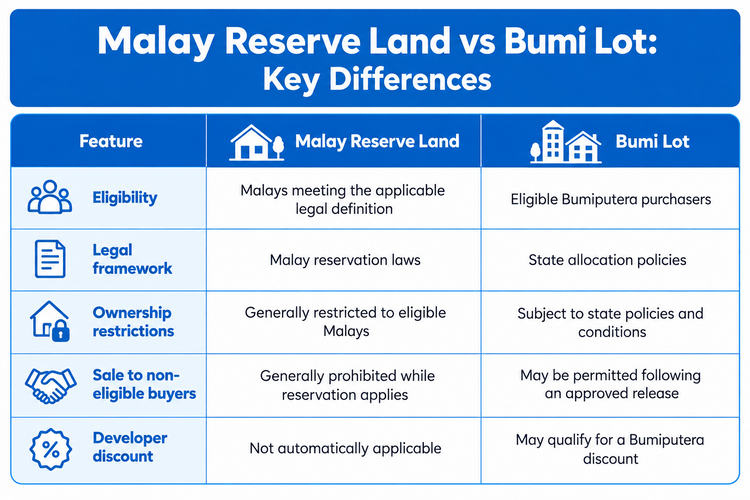
A Bumiputera Lot may be released for sale to a non-Bumiputera buyer under certain circumstances. However, that release process does not automatically apply to reserved land.
Browse apartments, condominiums, and serviced residences for sale in Malaysia.Who Can Buy And Own Malay Reserve Land?
Only individuals who qualify as Malay under the relevant state’s Malay Reservation Enactment can acquire reserved land.
However, the legal definition of Malay is not necessarily identical across all state enactments. Eligibility may depend on ancestry, religion, customary practices, or other statutory requirements.
This means:
- Malay buyers: May qualify, subject to the relevant state’s legal requirements.
- Non-Malay Bumiputera buyers: Are not automatically eligible simply because they have Bumiputera status.
- Non-Malay Malaysian buyers: Generally cannot acquire ownership while the land remains reserved.
- Foreign buyers: Generally cannot purchase reserved land.
Buyers should confirm their eligibility with the relevant Land Office before paying a deposit or signing a sale and purchase agreement.
Can Malay Reserve Land Be Sold Or Transferred To Non-Malays?
Land that remains under Malay reservation cannot be sold or transferred to a person who does not qualify under the applicable enactment.
This is different from a Bumiputera Lot, where a release application may sometimes allow a transfer to a non-Bumiputera purchaser.
However, Malay reservation status can be revoked through legally prescribed procedures. Article 89(3) of the Federal Constitution requires replacement land of similar character and equal area within the same state when a Malay reservation is revoked. Without the required replacement, the revocation is invalid.
Individual landowners should therefore not assume they can obtain a routine exemption to sell reserved land to non-Malay buyers.
How To Check Malay Reserve Land Status Before Buying A Property?
Before purchasing a property, it is important to verify whether the land is classified as Malay Reserve Land. This helps you identify ownership restrictions and determine whether you are eligible to complete the transaction.
Follow these steps to check the property’s status:
Step 1: Conduct An Official Land Search
Visit the relevant Land Office or Land Registry to request an official land search (carian rasmi). You will generally need the property’s title details, such as the lot number, title number, and district.
Step 2: Check The Land Title Details
Review the land search results for Malay reservation status, restrictions in interest, and other registered conditions. If the information is unclear, seek confirmation from the relevant Land Office.
Step 3: Confirm Your Eligibility To Purchase
Check whether you meet the definition of Malay under the applicable state’s Malay Reservation Enactment. Eligibility requirements can differ between states, so confirm them before proceeding.
Step 4: Verify Housing Loan Eligibility
Contact your preferred bank to determine whether it accepts the property as security for a housing loan. Ask about financing conditions and any additional approvals required.
Step 5: Consult A Conveyancing Solicitor
Engage a conveyancing solicitor to review the land title, ownership restrictions, and sale and purchase agreement. The solicitor can also advise on any necessary consent or transfer procedures.
Completing these checks before paying a deposit or signing an agreement can help you avoid ownership disputes, financing difficulties, and delays in transferring the property.
Calculate your monthly home loan repayments with the Mortgage Calculator.Can You Get A Housing Loan For Malay Reserve Land?
Obtaining a housing loan for Malay reserve land in Malaysia is possible, although approval depends on the financial institution’s lending policies, the property’s title conditions, and the applicable state legislation. Some banks may impose additional requirements or restrictions when financing these properties.
Some financial institutions may be cautious because ownership and transfer restrictions can limit the pool of eligible buyers if the property needs to be sold following a loan default. These restrictions may also affect the property’s valuation, financing margin, and the bank’s ability to register or enforce a charge over the land.
Before applying for a housing loan, consider the following:
- Bank eligibility: Confirm whether the bank provides financing for Malay Reserve Land.
- Financing margin: Check how much of the property’s value the bank is willing to finance.
- Title restrictions: Determine whether state consent or other approvals are required to register a charge.
- Loan requirements: Prepare the necessary income documents, property details, and land title information.
Comparing financing options and confirming the property’s legal status early can help you avoid unexpected delays or loan rejection during the purchasing process.
What Are The Common Issues Affecting Malay Reserve Land?
Despite its importance in preserving Malay ownership, reserved land can present several challenges for owners and developers.
- Multiple ownership: Inherited land may have several beneficiaries, making agreements on selling the property or developing it more complicated.
- Limited resale market: Ownership restrictions reduce the number of eligible purchasers, potentially affecting resale demand and marketability.
- Development challenges: Financing constraints, fragmented ownership, and land-use conditions can complicate development proposals.
- Valuation and compensation: Ownership restrictions and comparable transactions may affect valuations. Compensation for compulsory acquisition must be assessed under the applicable land acquisition laws.
These challenges do not affect every property equally. Location, ownership structure, permitted land use, and local market conditions remain important considerations.
What Happens To Malay Reserve Land When The Owner Dies?
Malay reserve land can form part of a deceased owner’s estate and may be inherited by eligible beneficiaries. However, inheritance does not remove existing ownership restrictions, and any transfer must comply with the relevant state’s Malay Reservation Enactment.
For Muslim estates, faraid principles generally determine inheritance shares. Beneficiaries may need documents such as a Faraid Certificate or distribution order before registering the property with the Land Office.
When multiple beneficiaries inherit the same property, future sales or transfers may become more complicated. Ownership eligibility, outstanding loans, and registration requirements should be reviewed with a qualified solicitor.
Making Informed Decisions About Malay Reserve Land
Malay reserve land plays an important role in preserving Malay land ownership in Malaysia. However, its legal restrictions can influence who can purchase, inherit, finance, or sell these properties. Understanding the applicable state laws and ownership conditions is essential to avoiding complications during property transactions.
Before making any property decision, buyers and owners should verify the land title, confirm eligibility, and review any financing or transfer restrictions. Seeking guidance from the relevant Land Office or a qualified solicitor can help ensure compliance with legal requirements and support informed decisions about property ownership.
Need practical advice on buying, selling, or owning a home? Explore Property Guides for useful property information on iProperty Malaysia.