

When buying a property, it can be difficult to tell how crowded a development may feel or what could eventually be built on the vacant land nearby. Price, location, built-up area, and facilities provide part of the picture, but they do not necessarily show how intensively a piece of land can be developed.
This is where plot ratio becomes useful. Plot ratio is a planning tool that determines how much floor space can be developed relative to the size of a plot of land. It can influence the overall scale and intensity of a development, although it does not by itself determine building height or the number of residents.
In this guide, we explain what plot ratio means in Malaysia, how to calculate it, how it differs from density, the current plot ratio controls in Kuala Lumpur, and what property buyers should check before making a purchase.
Search properties for sale in Malaysia and compare available homes.What Is Plot Ratio?
Plot ratio refers to the relationship between the total floor area of a building and the area of the building plot.
It is commonly expressed as a ratio such as 1:2, 1:4, or 1:8. Generally, a higher permitted plot ratio allows more floor space to be developed on the same amount of land.
However, plot ratio should not be treated as a direct measure of building height. The same amount of permitted floor area could potentially be arranged differently across a site, subject to building height, setbacks, land use, planning requirements, and other development controls.
In Malaysia, town and country planning is principally governed by the Town and Country Planning Act 1976 (Act 172). However, planning requirements and development controls can vary according to the relevant local authority and development plan.
Why Does Plot Ratio Matter To Property Buyers?
Plot ratio becomes particularly useful when you look beyond the individual unit and consider the wider development and neighbourhood.
When buying a property, consider:
- Development scale: A higher plot ratio can allow more floor space on the same land.
- Units and facilities: Consider the number of units and how many residents may share common facilities.
- Traffic and infrastructure: Larger developments may place greater demand on roads and surrounding infrastructure.
- Future development: Nearby land use and permitted intensity can indicate what may potentially be built.
Most importantly, avoid judging a property solely by its plot ratio. Consider the design, unit count, facilities, infrastructure, and location together.
How Do You Calculate Plot Ratio?
The basic plot ratio calculation is:
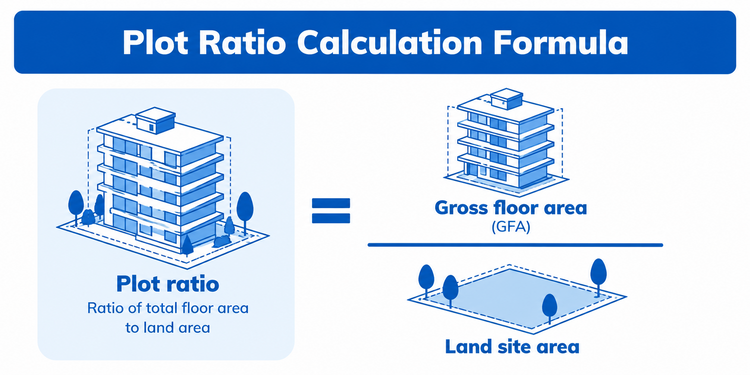
Alternatively, if you already know the permitted plot ratio, the potential floor area can be calculated as:
Potential floor area = Land area × Plot ratio
For example, suppose a site measures 10,000 sq ft and has a permitted plot ratio of 1:5.
10,000 sq ft × 5 = 50,000 sq ft
This means the permitted development could have up to 50,000 sq ft of floor area based on the plot ratio alone.
It does not necessarily mean the developer can automatically build exactly 50,000 sq ft. The eventual approved development remains subject to the applicable planning requirements and technical considerations.
What Is Gross Floor Area (GFA)?
Gross Floor Area (GFA) is closely connected to plot ratio because floor area forms part of the calculation.
Under the Town and Country Planning Act 1976, floor area is defined in relation to the total floor space within a building, measured between the external sides of walls or, for party walls, between the centres of those walls.
The basic formula for calculating the allowable GFA from a plot ratio is:
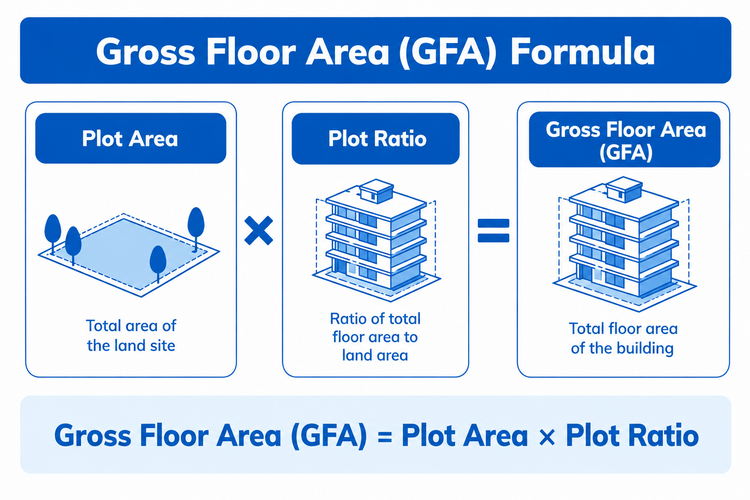
For example, if a plot measures 10,000 sq ft and has a permitted plot ratio of 1:5, the allowable GFA based on the plot ratio would be:
10,000 sq ft × 5 = 50,000 sq ft
However, buyers should be careful about assuming that every physical part of a development is necessarily included in the plot ratio calculation. What is included or excluded can depend on the relevant planning rules and local authority.
This is why the approved planning documents are more reliable than estimating a development’s plot ratio simply from its visible size.
Estimate your monthly home loan repayments with the Mortgage Calculator.Is Plot Ratio The Same As Density?
Plot ratio and density are related planning concepts, but they do not measure exactly the same thing.
| Plot Ratio | Density |
| Relates floor area to the area of the building plot | Relates the intensity of occupation or residential development to an area |
| Controls how much floor space may be developed | Can be expressed using measures such as people, dwelling units, or habitable rooms per unit area |
| Does not directly determine the number of residents | More directly relates to the intensity of occupation |
| Does not by itself determine building height | Does not by itself determine building height |
Two residential developments could therefore have a similar plot ratio but a different number of units.
For example, one development could contain fewer, larger homes, while another uses the available floor area for a greater number of smaller homes.
Who Determines Plot Ratio In Malaysia?
Plot ratio is controlled through the relevant planning framework and local planning authority rather than through one universal ratio for the whole of Malaysia.
The applicable ratio can depend on factors such as:
- Land use zoning: Residential, commercial, industrial, institutional, and mixed developments can be subject to different controls.
- Location: Development intensity can differ between city centres, established residential areas, and other locations.
- Infrastructure capacity: Roads, public transport, utilities, drainage, and other infrastructure can influence development planning.
- Site characteristics: The size, shape, topography, and surrounding environment of the land may affect what can ultimately be approved.
- Planning policies: Local plans and other applicable planning policies establish controls for particular areas.
- Additional planning requirements: Height limits, setbacks, heritage controls, environmental considerations, and other requirements can restrict development independently of plot ratio.
Therefore, a plot ratio used for one development should not automatically be applied to another site, even when the two properties are relatively close to each other.
What Are The Plot Ratio Controls In Malaysia?
There is no single plot ratio that applies across Malaysia. Development intensity is determined according to the applicable planning framework, local plan, land use zoning, and requirements of the relevant planning authority.
Kuala Lumpur provides one example of how these controls work. The Kuala Lumpur Local Plan 2040 (PTKL2040) was gazetted on 28 May 2025 and came into force on 11 June 2025. It now provides the key planning framework for land use and development intensity in Kuala Lumpur, with different basic plot ratios applying to different land use zones.
The basic plot ratios under PTKL2040 include:
| Land Use Zone | Basic Plot Ratio |
| City Centre Commercial (CCC) | Up to 1:10 |
| Major Commercial (MC) | Up to 1:8 |
| Commercial (C) | Up to 1:8 |
| Local Commercial (LC) | Up to 1:2 |
| Mixed Development (MX) | Up to 1:8 |
| Industrial (IP) | Up to 1:4 |
| Mixed Industry (MXI) | Up to 1:4 |
| Technology Park (TP) | Up to 1:3 |
| Residential 2 (R2) | Up to 1:2.5 |
| Residential 3 (R3) | Up to 1:4 |
| Residential 4 (R4) | Up to 1:6 |
| Traditional Village 2 (TV2) | Up to 1:2 |
| Institutional (INT) | Up to 1:4 |
| Public Facilities (PF1) | Up to 1:2 |
| Private Facilities (PF2) | Up to 1:2 |
These basic plot ratios do not automatically apply as the approved development intensity for every site. The actual intensity of a particular plot must be checked against the applicable intensity map and other planning controls.
DBKL (Dewan Bandaraya Kuala Lumpur) states that development intensity is also subject to technical requirements, policies, and guidelines, and a lower intensity may be considered where these requirements cannot be met.
PTKL2040 also provides development incentives in qualifying circumstances, including developments near public transport, redevelopment projects, lot amalgamation, and developments incorporating affordable housing.
Does A Higher Plot Ratio Always Mean A Higher-Density Development?
A higher plot ratio allows more floor area relative to the land area, so it can support a larger development. However, it does not tell buyers exactly how many residential units will be constructed.
Consider two projects with the same permitted floor area. One could contain many smaller units, while another could contain fewer but substantially larger homes.
The layout of the towers, number and size of units, common areas, site coverage, building height, and other planning and design factors also matter.
For homebuyers, the actual number of units, number of units per floor, number of lifts, facilities, parking provision, and overall site layout can provide more practical information about how busy a completed development may feel.
Read Property Guides for useful insights on Malaysia’s property market.Does Plot Ratio Determine How Tall A Building Can Be?
A plot ratio controls floor area rather than directly specifying the number of storeys.
Imagine two developments that are permitted the same amount of floor area. One might spread that floor space across a wider footprint and fewer floors. Another could occupy a smaller portion of the site and distribute its floor space vertically.
Building height can be controlled separately.
PTKL2040, for example, uses plot ratio controls for various development categories while height controls apply to specified types of development. Other site-specific controls can also affect the eventual building form.
Therefore, buyers should not use plot ratio alone to predict the future height of a neighbouring development.
How Can You Find The Plot Ratio Of A Property?
Plot ratio information may be available through the relevant local authority’s development plans, zoning maps, intensity maps, planning documents, or approved Development Order.
If you are researching a property, you can:
- Identify the local authority responsible for the area.
- Check the applicable local plan and land use zoning.
- Look for the development intensity or plot ratio applying to the particular site.
- Check whether additional planning controls apply.
- Ask the developer about the approved Development Order for a new project.
- Contact the relevant local authority if the information is unclear.
For Kuala Lumpur, buyers should refer to PTKL2040, including its land use and intensity controls, rather than relying on the older Kuala Lumpur City Plan 2020.
Can A Plot Ratio Be Changed?
A plot ratio is not necessarily fixed permanently, but a landowner cannot simply increase it. Any change to development intensity must follow the applicable planning framework and approval process, taking into account factors such as land use, location, existing approvals, site conditions, and requirements of the relevant planning authority.
In Kuala Lumpur, PTKL2040 provides for development incentives in qualifying circumstances, while changes to the plan must follow DBKL’s prescribed procedures. Buyers should therefore distinguish between the basic plot ratio for a land use zone and the development intensity ultimately approved for a specific site.
What Should Buyers Check Before Purchasing?
Before purchasing a home in a high-rise or mixed development, look beyond the plot ratio itself. Consider:
- Development size: Check the total number of units, blocks, and units per floor.
- Lifts and common facilities: Consider how many residents will share lifts, pools, gyms, and other facilities.
- Parking and access: Review resident and visitor parking, access roads, and entry and exit points.
- Maintenance charges: Check the expected recurring costs for maintaining common property and facilities.
- Transport and infrastructure: Consider nearby public transport, roads, and supporting infrastructure.
- Future development: Check the zoning and permitted development intensity of nearby vacant or underdeveloped land.
Plot ratio is therefore best treated as one part of your property due diligence, rather than a standalone measure of whether a development will be crowded or comfortable.
Plot Ratio Helps You See The Bigger Picture
Plot ratio helps buyers understand how intensively a piece of land can be developed. However, it should be considered alongside unit count, zoning, building height, site layout, infrastructure, and facilities to get a clearer picture of a development.
For buyers in Kuala Lumpur, the current PTKL2040 framework is an important reference for land use and development intensity. Always check the approved details for the specific development and surrounding land before making a property decision.
Looking for a newly launched property that suits your lifestyle and budget? Discover new homes for sale in Malaysia and explore your options on iProperty Malaysia.